
This is the report from the Nacogdoches County Jail that lists the arrests made from 6 a.m. of the previous day to 6 a.m. of the listed day.

This page may take a moment to load
This is the report from the Nacogdoches County Jail that lists the arrests made from 6 a.m. of the previous day to 6 a.m. of the listed day.
This page may take a moment to load

This is a complete list of reports responded to by the Nacogdoches Police Department
This page may take a moment to load.
This is the report from the Nacogdoches County Jail that lists the arrests made from 6 a.m. of the previous day to 6 a.m. of the listed day.
This page may take a moment to load
At 11:18 am this morning, the Nacogdoches Police Department responded to a three vehicle automobile crash in the 2300 block of Southeast Stallings Drive (Loop 224).
It eas determined that a 2012 Peterbuilt tractor trailer, loaded with logs, was travelling east on SE Stallings. The driver of the truck was identified as John Keith Ferguson, age 41 of Nacogdoches. The truck is owned by D. Fields Trucking of Nacogdoches.
Behind the truck was a Chevrolet Captiva SUV, driven by Emmanuel Alia, age 55, of Missouri City, Texas.
Traffic slowed and the Chevrolet Captiva struck the log truck from the rear. Mr. Alia was transported to a local hospital by ambulance, where he was pronounced dead.
A third vehicle, a Honda CRV, being driven by Brenda Rodriguez, age 51 of Stafford, Tx. was behind the Chevrolet, and struck the Chevrolet from behind.
No one else was injured in the accident. In addition to NPD, the Nacogdoches Fire Department, Nacogdoches Ambulance Service, Texas Department of Transportation and the Texas Highway Patrol responded to the scene.
Faculty members of the Stephen F. Austin State University School of Music will be the featured performers during the annual Pi Kappa Lambda Music Faculty Showcase at 7:30 p.m. Thursday, Sept. 18, in Cole Concert Hall on the SFA campus.
“This concert showcases the talents of our diverse faculty,” said Deborah Dalton, SFA associate professor of voice and president of the local chapter of Pi Kappa Lambda, the national music honor society.
“In addition, all proceeds benefit the Pi Kappa Lambda scholarship we give each year to the sophomore music major with the highest grade point average,” Dalton said. “For the past few years, awards were given to several sophomores with 4.0 grade-point averages.”
From Beethoven to Gershwin
The musicians have selected a wide range of musical styles and will perform in a variety of solo and ensemble settings.
Among the composers’ works to be performed are Ludwig van Beethoven, Felix Mendelssohn, George Gershwin, John Duke and David Gillingham.
Faculty vocalists to perform include mezzo-sopranos Nita Hudson and Deborah Dalton, soprano Charlotte Davis, tenor Tod Fish and baritone Chris Turner. Also performing will be pianists Mario Ajero, Mary Cooper, Geneva Fung and Ron Petti, along with Brad Meyer, marimba; Cheyenne Bland Cruz and Christopher Ayer, clarinets; Staci Spring, bassoon; Christina Guenther, flute; John W. Goodall, oboe; Charles Gavin, horn; Gary Wurtz and Justin Wood, trumpets; and Larry Greer, guitar.
“This is one of the most popular concerts of the year because there is truly something for everyone,” Dalton said.
The program features a variety of songs, ranging from Beethoven’s Sonata in F Major, Op. 10, No. 2 to Gershwin’s popular “Summertime.”
The recital is a joint presentation of the SFA College of Fine Arts and School of Music and is a part of the 2014-2015 Cole Performing Arts Series. Cole Concert Hall is located in the Wright Music Building at 2210 Alumni Drive.
Tickets are $12 for adults, $8 for seniors and $5 for students. For tickets or more information, please visit www.finearts.sfasu.edu or call (936) 468-6407 or (888) 240-ARTS.
This is the report from the Nacogdoches County Jail that lists the arrests made from 6 a.m. of the previous day to 6 a.m. of the listed day.
This page may take a moment to load
This is a complete list of reports responded to by the Nacogdoches Police Department
This page may take a moment to load.
This is the report from the Nacogdoches County Jail that lists the arrests made from 6 a.m. of the previous day to 6 a.m. of the listed day.
This page may take a moment to load
Members of the Nacogdoches Police Department recently began a program to foster positive contacts with school age children in Nacogdoches.
NPD officers began last week contacting school students at bus stops around the city, giving away pens, pencils, erasers and granola bars. Officers target different areas of the city, with no specific schedule.
“This program is designed to initiate positive contacts with the children and develop good relationships in an informal setting”, said Nacogdoches Police Chief Jim Sevey.”In the first week, officers contacted 411 children”.
The contacts were made at over 100 different locations in the city.
The department plans to continue this program during the school year.
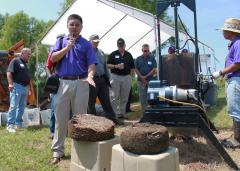
Dr. Shiyou Li, director of the National Center for Pharmaceutical Crops at SFA, explains the process of extracting and applying the biocidal compound found in giant salvinia. The dried cakes of vegetation visible in the foreground are the result of the extraction process.
Researchers at the National Center for Pharmaceutical Crops located at Stephen F. Austin State University’s Arthur Temple College of Forestry and Agriculture have developed a novel concept for addressing invasive species by utilizing compounds present in the organism. Endogenus biocide, or endocide, refers to an agent derived from a source that does not cause apparent poison in normal growth of the producing plant, but, when exposed, has biocidal effects in that species.
After three years of extensive investigations in lab and field trials, the researchers determined giant salvinia extracts and one of its fractions from giant salvinia successfully controlled the invasive plant in various stages of growth without negatively affecting surrounding flora and fauna. The invitation-only event in Louisiana provided natural resource managers and government representatives with an overview of the research, as well as a firsthand look at the extraction process and results.
“What brings people together is a common enemy,” said Dr. Steve Bullard, dean of the Arthur Temple College of Forestry and Agriculture. “And invasive species are that enemy.”
Giant salvinia was brought to the U.S. from Brazil in the 1980s as an ornamental aquatic fern. Since its introduction to native waterways, the plant has invaded lake and river systems in the southeastern United States, California, Arizona and Hawaii. Salvinia forms dense mats of vegetation, which negatively affects water quality, destroys wildlife habitat and limits recreation. In favorable conditions, the plant can double its biomass in two to three days, making its control a struggle for natural resource agencies.
“We treat anywhere between 60,000 and 90,000 acres a year,” said Alex Perret, aquatic plant control coordinator for the Louisiana Department of Wildlife and Fisheries. “We’re always treating wide open water bodies with giant mats of this stuff.”
According to Biologist Supervisor Sean Kinney with the Louisiana Department of Wildlife and Fisheries, the agency currently uses a combination of herbicide and salvinia weevils to stem the invasive plant’s spread. However, Kinney notes, herbicide is very limiting due to its negative effects on surrounding flora.
Collaboration was a key theme throughout the meeting, with researchers and participants discussing future steps for larger scale studies of endocide application. The partnership between the Red River Waterway Commission and the National Center for Pharmaceutical Crops began after Bullard heard a Red River Radio interview with Executive Director Ken Guidry in which he discussed the commission’s research of weevils as a method of bio control. Bullard said he immediately contacted Guidry in hopes of collaborating to address the damaging invasive plant.
“It’s a great opportunity for us all,” said Guidry. “We get more done when we’re working in the same direction.”
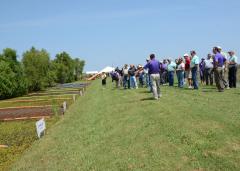
Natural resource and invasive species specialists observe test plots utilizing endogenus biocide, or endocide, to control the invasive species giant salivinia at the Red River Waterway Research Center in Lena, Louisiana. Endocide refers to an agent derived from a source that does not cause apparent poison in normal growth of the producing plant, but, when exposed, has biocidal effects in that species. The concept, developed by researchers at SFA’s National Center for Pharmaceutical Crops, is species specific and does not negatively affect surrounding flora or fauna.
“One way in which we envision doing that with the help of our congressional representatives and our senators is having a meeting in Washington, D.C., of agencies, funders and researchers,” Bullard explained. “Because in the world of science, it’s all about peer replication, and we know we need to take that step.”
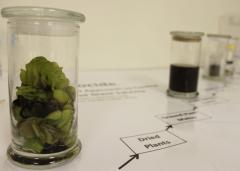
Giant salvinia is one of the South’s most damaging aquatic invasive species, forming dense mats of vegetation that severely impairs water quality and destroys wildlife habitat. The application of endocide, patent pending, holds promise in controlling salvinia, and research regarding its effectiveness in controlling other invasive species is underway.