An asteroid discovered at the Stephen F. Austin State University Observatory in Nacogdoches in 1999 has been officially named Carona in honor of late Texas A&M University astronomer Don Carona. Image credit: Dr. Dan Bruton
An asteroid discovered at the Stephen F. Austin State University Observatory in Nacogdoches in 1999 has been officially named Carona in honor of late Texas A&M University astronomer Don Carona.
The minor planet, now designated (102216) Carona, was discovered Oct. 3, 1999, by Carona and Billy Dink McCormack ’10, who earned a Bachelor of Applied Arts and Sciences at SFA and now serves as a football coach and math teacher for Cushing Independent School District. In 1999, Carona and McCormack were part of a minor-planet observing program established and directed by Dr. Dan Bruton, SFA Planetarium director and professor of physics, engineering and astronomy.
“Don and I worked closely together at the Texas A&M Physics and Astronomy Observatory in the early 1990s, and that collaboration grew into a lasting friendship,” Bruton said. “While conducting minor-planet observations together, we reported an unknown object that was later confirmed as a new minor planet.”
The International Astronomical Union’s Working Group for Small Body Nomenclature announced the name in the April 13 issue of its official bulletin. Once approved by the IAU, an asteroid’s name becomes its internationally recognized permanent designation.
“It’s fitting that it now carries Don’s name,” Bruton said. “His enthusiasm for astronomy and his dedication to education left a lasting impact on students and staff alike, and I’m grateful this discovery preserves that legacy.”
The official IAU citation describes Carona, former manager of the Texas A&M Physics and Astronomy Observatory, as an educator whose “dedication to observational astronomy and public outreach inspired countless students and community members.”
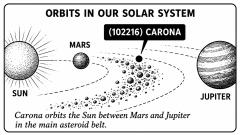
Asteroid (102216) Carona orbits the sun between Mars and Jupiter “as a lasting marker of Carona’s contributions to astronomy education and his role in the discovery at the SFA Observatory,” Bruton said.
The SFA Observatory has continued as a site for minor-planet research, with Bruton’s students discovering 11 minor planets there. To learn more about the observatory, visit gosfa.com/observatory.
ABOUT STEPHEN F. AUSTIN STATE UNIVERSITY
Stephen F. Austin State University, the newest member of The University of Texas System, began a century ago as a teachers’ college in Texas’ oldest town, Nacogdoches. Today, it has grown into a regional institution comprising six colleges — business, education, fine arts, forestry and agriculture, liberal and applied arts, and sciences and mathematics. Accredited by the Southern Association of Colleges and Schools, SFA enrolls approximately 11,000 students while providing the academic breadth of a state university with the personalized attention of a private school. The main campus encompasses 421 acres that include 40 academic facilities, 11 residence halls, and 68 acres of recreational trails that wind through its six gardens. The university offers more than 80 bachelor’s degrees, more than 40 master’s degrees and four doctoral degrees covering over 120 areas of study. Learn more at sfasu.edu.
By University Marketing Communications