
This is the report from the Nacogdoches County Jail that lists the arrests made from 6 a.m. of the previous day to 6 a.m. of the listed day.

This page may take a moment to load
This is the report from the Nacogdoches County Jail that lists the arrests made from 6 a.m. of the previous day to 6 a.m. of the listed day.
This page may take a moment to load
This is the report from the Nacogdoches County Jail that lists the arrests made from 6 a.m. of the previous day to 6 a.m. of the listed day.

This page may take a moment to load
If you are having trouble loading the mugshots please try using a different internet browser
 The Nacogdoches Police Department has successfully completed the inspection by the Texas Police Chiefs Association as part of their participation with the TPCA Accreditation Program. NPD was the 24th agency in the State of Texas to become recognized as following Texas Law Enforcement Best Practices on February 11, 2010. Since that time NPD has maintained this accreditation by successfully passing each inspection. Currently there are approximately 175 TPCA recognized agencies out of 2,720 total agencies in the state of Texas.
 The School of Theatre at Stephen F. Austin State University will present William Shakespeare’s “The Taming of the Shrew” at 7:30 nightly through Saturday, April 9, in Kennedy Auditorium on the SFA campus. SFA theatre students, from left, Jaz’Lyn Lewis of Longview and Mariano Aguirre of Little Elm perform in a scene from the play. General ticket prices are: $15, adult; $10, senior (62+); $7.50, SFA faculty/staff; $7.50, youth; $5, student. Purchase tickets at boxoffice.sfasu.edu or call (936) 468-6407. For questions about the play, contact the School of Theatre at (936) 468-4003.
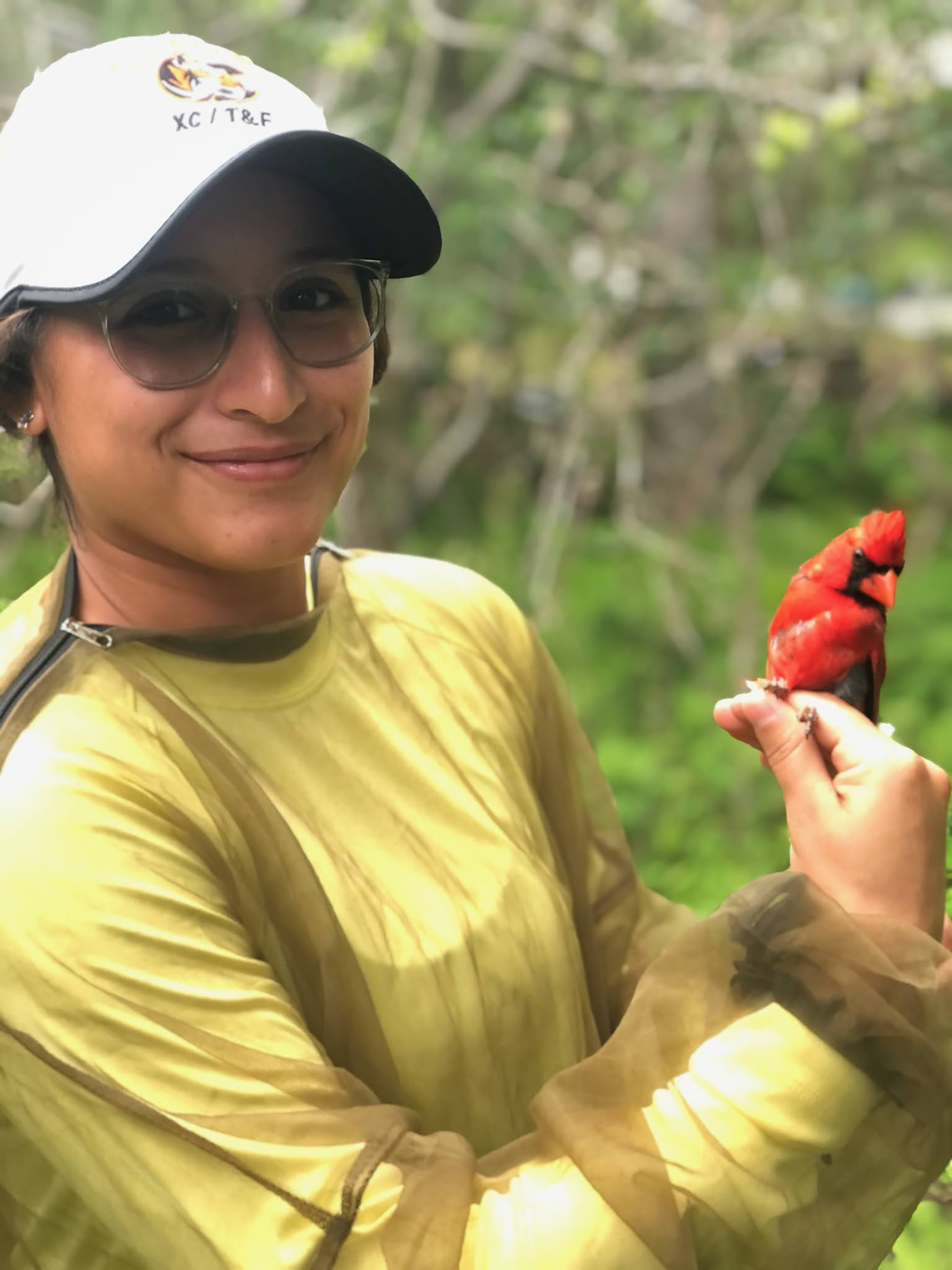
Current research indicates a significant loss in avian abundance and diversity during the past 50 years in North America. With this in mind, three Stephen F. Austin State University forestry graduate students are conducting research across Texas and the Mississippi alluvial valley to advance avian conservation practices and augment available scientific data. Pictured is Alejandra Martinez, SFA forestry graduate student, holding a Northern cardinal captured during her field work.
As welcome as these species are to the state, Texas is not immune to data indicating a significant loss in avian abundance and diversity during the past 50 years.
“I know for me, not just being a student, but also being a birder for about 14 years, I’ve noticed a decline in birds,” said Eamonn Thurmond, who is pursuing a Master of Science in Forestry at Stephen F. Austin State University. “When the 2019 Rosenburg paper came out, it seemed par for the course. It didn’t surprise us, but it was very much disappointing.”
The 2019 paper Thurmond is referring to was a collaborative research effort across nine separate universities, governmental agencies and organizations that found an approximate net loss of roughly 3 billion birds since 1970. Currently, Thurmond is one of three SFA forestry graduate students conducting research to continue to shed light on current avian population trends, as well as land management practices that benefit these species.
Thanks to a grant from the National Fish and Wildlife Foundation, Thurmond, under the direction of Dr. Rebecca Kidd, SFA associate professor of forestry, will analyze 150 study sites within bottomland hardwood forests across Louisiana, Arkansas and Mississippi. These sites, located within the Mississippi alluvial valley, are part of a national effort to restore bottomland hardwood forest ecosystems that have been drastically altered or lost due to anthropogenic, or human-based activities.
Through initiatives such as the Wetland Reserve Program, a voluntary program assisting landowners in protecting, restoring and enhancing wetlands and riverine ecosystems, progress has been made in restoring critical bottomland hardwood forest habitat. On these sites, active forest management practices, such as invasive species control, thinning and regeneration harvests, complement naturally occurring disturbances, such as flooding and falling trees.
“The goal of this research is to see how avian communities are changing or responding over time to the intensity of forest management from the early successional stage to the ideal, mature forest stage,” Thurmond said.
In order to document these changes, Thurmond will deploy automated sound recording units at 75 different forest sites for two summers. These waterproof, compact recording units can be programmed to record at specific times of the day for set lengths of time and later analyzed to discern which species are utilizing the study site.
“On one of my recordings, I started laughing because I got 11 different species vocalizing within the first 20 seconds of the recording,” Thurmond said with a smile. “The fact you can get 11 species within that short time should emphasize how many birds are there, and it’s a good metric for looking at communities present.”
Thurmond explained that complexity within the vertical forest structure is typically best for forest birds because it provides a variety of resources for multiple species. His findings will help guide foresters in making future management decisions to benefit songbirds within these restored bottomland forests.
Closer to home, forestry graduate student Liam Wolff is investigating how forest conditions affect an avian species recognized by the Texas Parks and Wildlife Department as a species of conservation concern. His research, directed by Dr. I-Kuai Hung, Lacy H. Hunt Professor of geospatial sciences at SFA, is supported in part by the State and Tribal Wildlife Grants Program.
Bachman’s sparrows are habitat specialists that rely on open pine woodlands with grassy understories like those historically found across East Texas. According to the Cornell Lab of Ornithology, populations of this small, brown songbird have declined by 76% during a span of 44 years. This is due in large part to land conversion, fire suppression and other alterations to native forest composition.
“The strongest argument for the protection of this species is that it is a bioindicator and occurs in the same habitat as the endangered red-cockaded woodpecker,” Wolff said. “So, if you’re conserving this species, there’s a whole other slew of species you’re also protecting — and not just birds. There are some plants associated with these habitat types, and in Eastern populations, you have the federally threatened gopher tortoises and Louisiana pine snakes.”
Wolff’s study sites are located across public and private lands throughout the post oak savannah and piney woods ecoregions of East Texas.
During multiple seasons, Wolff will examine the spatial and temporal factors that influence the occupancy, phenology and detection of Bachman’s sparrows in East Texas. This includes canopy cover, forest basal area, percent ground cover of grasses, leaf litter and more.
“These data can inform agencies and land managers on habitat preferences of Bachman’s sparrows, as well as occupancy and distribution of this species of greatest conservation need in Texas,” Wolff said. “We’re also looking at a regional-scale predictor of how far a surveyed plot is from a source population. What that can imply is whether habitat fragmentation is affecting whether or not these birds are able to move between certain areas.”
For example, Wolff said there are a number of restored habitats in East Texas capable of supporting the Bachman’s sparrow, but the species has not been detected.
Automated sound recording units are again key to detecting the presence or absence of the Bachman’s sparrows. Thankfully, Wolff and other students have access to software to assist in sorting this massive amount of audio.
“In addition to the audio, the software represents sound visually,” Wolff said. “If you familiarize yourself with the spectrogram signature of your species, you can just scan through and visually look for that signature. Fortunately, the Bachman’s sparrow signature is pretty unique.”
At the Welder Wildlife Refuge in South Texas, forestry graduate student Alejandra Martinez will analyze six years of data collected over a 12-year period through a MAPS station within a riparian woodland to determine occupancy and population trends of birds.
“The acronym stands for Monitoring Avian Productivity and Survivorship,” Martinez explained. “MAPS is one of the first resources used to collect long-term breeding data on the land bird populations of North America, including productivity indices.”
There are more than 1,300 MAPS stations across North America, and data collected at each of these stations is publicly available.
During a span of three years, Martinez, under the direction of Dr. Jessica Glasscock, SFA assistant professor of forest wildlife management, will gather comprehensive data from birds collected through mist nets as outlined by the established MAPS protocol. She will then compare her data to previous years to determine if there are any population trends or shifts occurring.
She notes that initial findings indicate a decline in common species, such as the Northern cardinal, known for its bright red feathers and expansive range across the United States.
“We ran a species rank abundance curve and ranked the top three most abundant species by year, and it was really interesting to see that the most abundant species someone can think of — this generalist species — has declined at this local scale,” Martinez said.
Additionally, Martinez will compare the effectiveness of automated sound recording units and established MAPS protocols in determining occupancy and time of detectability.
“We want to see if the recording units are more efficient because we’re not going to catch every single bird that may be present,” Martinez said. “When we’re not running our nets and collecting birds, we’re supposed to be listening to document species flying over. Hopefully, with the recording units, we can pick up a more complete population or complete community of avians in this riparian corridor.”
For more information on this and other research occurring through the Arthur Temple College of Forestry and Agriculture, visit sfasu.edu/atcofa.
Story by Sarah Fuller, outreach coordinator for Stephen F. Austin State University’s Arthur Temple College of Forestry and Agriculture. Contact information: (936) 468-1185 or fullersa@sfasu.edu.

From left, senior nursing student Ainslie Sylvest and dietetics and nutritional sciences senior Zarea Collins participate in a mock ICU lab simulation using a case study for Type 1 diabetes.
The simulation, delayed for two years due to COVID-19, was the first of its kind, with third-semester nursing students role-playing as patients and dietetics students role-playing as professionals in a clinical setting.
“This mimics what they’ll see in a hospital setting,” said Justin Pelham, clinical instructor for food, nutrition and dietetics in the School of Human Sciences. “What does a dietitian do in a clinical setting? Can they handle a case study and apply it? I wanted to bring the lab experience to this class.”
The simulation provided hands-on experience for both dietetics students looking to finish their degrees and nursing students wanting to learn more about the patient’s perspective.
Each dietetics student had a 20-minute interval to talk with their patient and then prepare an initial nutrition assessment consisting of assessment, diagnosis, intervention and plan for monitoring and evaluation at a follow-up. Pelham coordinated the event and served as preceptor for his 16 participating students.
During the simulation, a student would sit or stand at bedside with a patient and ask questions from a chart. While some questions were about routine things — age, weight, employment and food history — the student was able to get enough information to pinpoint an important issue, like the necessity for a patient with diabetes to replace the food or beverages they like most if they want their health to improve.
Simulations took place March 29 and 30 at a mock ICU lab at the DeWitt School of Nursing Complex. Due to a partnership with Tarleton State University, some simulations were conducted via Zoom.

Ajani Brown holds the Mitchell A. Wilder Silver Publication Design Award while standing next to his poster that was used to market the event “Esperanza’s Night Out at the Stone Fort Museum” in October. The award, named in honor of early museum publication advocate and founding director of the Amon Carter Museum in Fort Worth, recognizes excellence in museum graphic design and publications across Texas.
“I take immense pride as a staff member in representing the museum at the state level,” Brown said. “I was absolutely ecstatic hearing my design could win the museum this award. It felt amazing to know that the work I put into graphic design and illustration classes at SFA has paid off. I also felt a huge sense of pride in my family knowing they were my greatest support.”
The award recognizes and promotes the highest standards of graphic design and media production in museum publications, including invitations, newsletters, brochures, books, catalogues and posters, among other marketing and supplementary materials. The award is named in honor of one of the early advocates in museum publications, Mitchell A. Wilder, founding director of the Amon Carter Museum in Fort Worth.
“The award was established to recognize excellence in museum publications, and the recognition of Ajani’s work goes hand-in-hand with the museum’s goal to provide SFA students with transformational learning opportunities,” said Carolyn Spears, Stone Fort Museum director.
Brown drew inspiration from Sandra Cisneros’ novel, “A House on Mango Street,” which was the basis of the event. The heroine and narrator, Esperanza Cordero, is depicted in the poster in a pose similar to the Statue of Liberty, and is holding a book in place of a torch to illustrate how she used writing to empower those like her and needed a light to clear their path.
“Esperanza’s Night Out at the Stone Fort Museum” was held in collaboration with the Nacogdoches Public Library’s Big Read grant in October. The event included a variety of activities including a poetry slam featuring guest poet, Qui Quarre, of Nairobi, Kenya.
By Nathan Wicker, marketing communications specialist at Stephen F. Austin State University.
NPD Crime Report
This is the report from the Nacogdoches County Jail that lists the arrests made from 6 a.m. of the previous day to 6 a.m. of the listed day.
This page may take a moment to load
If you are having trouble loading the mugshots please try using a different internet browser
This is the report from the Nacogdoches County Jail that lists the arrests made from 6 a.m. of the previous day to 6 a.m. of the listed day.
This page may take a moment to load
This is the report from the Nacogdoches County Jail that lists the arrests made from 6 a.m. of the previous day to 6 a.m. of the listed day.
This page may take a moment to load
If you are having trouble loading the mugshots please try using a different internet browser