
This is the report from the Nacogdoches County Jail that lists the arrests made from 6 a.m. of the previous day to 6 a.m. of the listed day.

This page may take a moment to load
This is the report from the Nacogdoches County Jail that lists the arrests made from 6 a.m. of the previous day to 6 a.m. of the listed day.
This page may take a moment to load

This is a complete list of reports responded to by the Nacogdoches Police Department
This page may take a moment to load.
This is a complete list of reports responded to by the Nacogdoches Police Department
This page may take a moment to load.
This is a complete list of reports responded to by the Nacogdoches Police Department
This page may take a moment to load.
This is the report from the Nacogdoches County Jail that lists the arrests made from 6 a.m. of the previous day to 6 a.m. of the listed day.
This page may take a moment to load
This is the report from the Nacogdoches County Jail that lists the arrests made from 6 a.m. of the previous day to 6 a.m. of the listed day.
This page may take a moment to load
This is the report from the Nacogdoches County Jail that lists the arrests made from 6 a.m. of the previous day to 6 a.m. of the listed day.
This page may take a moment to load
This is the report from the Nacogdoches County Jail that lists the arrests made from 6 a.m. of the previous day to 6 a.m. of the listed day.
This page may take a moment to load
An exhibition that runs Aug. 28 through Oct. 17 in Griffith Gallery on the Stephen F. Austin State University campus will feature the detailed work of Northwest artist Thomas Wood.
“Myth & Metaphor: The Intaglio Prints of Thomas Wood” will feature an exhibition of 45 prints by Wood, who has created narrative and mythical metaphors about the world through his detailed prints, according to John Handley, director of art galleries for SFA’s School of Art.
“Whether dealing with a landscape or the reinvention of some place or still life, Wood’s use of line, composition and subject matter is masterful,” Handley said.
Wood has been compared to old masters such as Albrecht Dürer (1471 – 1528) and Hieronymus Bosch (c. 1415 – 1516) in his continuation of the art of printmaking, Handley explained.
“He often incorporates multiple techniques in a single print, including etching, aquatint, mezzotint and Chine collé,” Handley said.
Wood lives in Bellingham, Wash., located at the northern end of Puget Sound. Many of his landscapes bear a resemblance to those of the artist Helen Loggie (1895 – 1976), who also lived and worked in the area, according to Handley.
“Both artists capture the essence of the area’s landscape – the trees, undergrowth and hills – that seem unique to Northwest Washington,” he said.
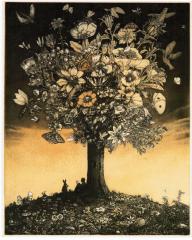
Among the works of artist Thomas Wood that will be featured in an exhibition running Aug. 28 through Oct. 17 in Griffith Gallery on the SFA campus is “The Pollinators,” 2007.
The display will open with a reception from 5:30 to 7 p.m. Aug. 28. Griffith Gallery is located in the Griffith Fine Arts Building, 2222 Alumni Drive.
This exhibition is made possible in part by a grant from Humanities Texas, the state affiliate of the National Endowment for the Humanities.
All SFA art exhibitions, receptions and gallery talks are free. For more information, call (936) 468-1131.
A university research initiative this past summer took an art professor at Stephen F. Austin State University to Salvador, Brazil. In addition to fulfilling multiple research goals, the exchange gave Lauren McAdams Selden, the associate professor of art metals for the SFA School of Art, a more universal view of the world.
Selden was part of a group of 13 professors and six graduate students who participated in a program aimed at creating and fostering relationships in Salvado Da Bahia, Brazil. Working with de Araújo Santos, professor of ceramics at Escola de Belas Artes at the Universidade Federal da Bahia, and with the assistance of SFA graduate student/translator Jaime Heredia, Selden gave a demonstration to the ceramic students about how to create mokume gane, a Japanese metalworking technique, using two different clay bodies and natural pigments.
A highlight of the trip was Selden’s participation in the third Bienal da Bahia in an educational event (Ateliê Livre das Oficinas do MAM, or open workshop of the Museum of Modern Art, a project that welcomes artists who wish to work on their projects or develop their artistic processes in the museum’s workshop space) working directly with the educational department coordinated by Eliane Moniz de Aragão Simões and with Felix White Toro, coordinator of the museum’s workshops.
“The Bienal was especially important because it was the first time that the region has had the event since 1968,” Selden said.
In 1966, the historic first Bienal strived to decentralize art in Brazil and bring together artists from different parts of the country to highlight the important work being done in Bahia and the northeast. In 1968, as a result of the military coup d´état, the second Bienal was interrupted, works were confiscated and artists were arrested.
This year, the launch of the third Bienal shared faith in ideas and dialogue and an impressive 100-day schedule of art, education and experiential activities, according to Selden.
“It was an honor to be able to illustrate a particular art-making process by building a 5 x 2 x 2 meter inflatable sculpture named Zé as part of the discussion of ‘É Tudo Nordeste?’” Selden said. “Considering the strong history of the Bienal da Bahia and the persistence of a region longing to express itself artistically, the representative plastic inflatable only seemed fitting to illustrate potential energy, success, failure and a constant human will to proceed, to fight and to believe.
“I hope that this plastic sculpture, with the use of simple every day materials, allowed for an additional experience in the educational programming that the museum offers,” she said. “I truly hope that I can participate in future events, educational opportunities and creative presentations at the Museum of Modern Art of Bahia.”
Brazil and its people deeply impacted Selden, and her future works will reflect the effects the country had on her life and her art.
“In previous works, I have focused on ideas of potential energy, refugee experiences, adaptations for survival, and the power of contemporary female figures,” she said. “All of these themes are globally applicable. I plan to create multiple works of art directly inspired by my experience in Brazil.”
This work will be on display in February at Northwestern State University in Natchitoches, La. Selden is also negotiating a second exhibition in March
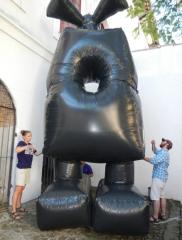
Lauren Selden, associate professor of art metals for the SFA School of Art, and Zac Selden install an inflatable sculpture for the Bienal da Bahai this past summer in Brazil.
“After the exhibitions in the United States, I hope to have an exhibition in Brazil,” she said. “Brazil has changed my view as an artist, and I want to show the people in these regions another perspective in the universal language of art.”
Selden believes continuing to practice speaking, reading and writing in the Portuguese language will give her new opportunities.
“The interactions that I have had with the students and makers in Brazil will continue to impact my work and have a direct effect on the students that I teach in the United States,” she said. “It is a valuable asset in the field of fine arts to have a more universal view of the world, and I know that this experience will allow me to be a better artist and teacher.”