September 10, 2015: Nacogdoches County Booking Report

This is the report from the Nacogdoches County Jail that lists the arrests made from 6 a.m. of the previous day to 6 a.m. of the listed day.

This page may take a moment to load

If you are having trouble loading the mugshots please try using a different internet browser

Click Here to load a separate PDF file

Posted in All Police, Booking | Leave a comment

Home For Rent: 219 cr 4193 Nacogdoches tx

Bed/Bath: 3 be 1.5 bath

Square Footage: 1800

Address: 219 cr 4193 Nacogdoches tx

Description: Cute place on 2 acres.
Woden ISD

Lease options may be considered.

Rent is $850

Cost: 850

Contact: Burl Evans

Phone: (936) 560-1448

Email: lmprlty@sbcglobal.net

Posted in Classifieds, Homes for sale by owner, MarketPlace | Leave a comment

SFA’s Arthur Temple College of Forestry and Agriculture to host community-wide competition

Stephen F. Austin State University’s Arthur Temple College of Forestry and Agriculture in partnership with Nacogdoches Parks and Recreation will host NacogdoTREES, a free, community-wide competition celebrating the natural beauty of the city and campus, through Sunday, Nov. 1.

“The goal of the NacogdoTREES competition is to highlight the importance of urban and community trees, raise awareness of their ecological benefits, introduce the community to the field of forestry and encourage citizens to spend time outdoors,” said Sarah Fuller, outreach coordinator for SFA’s Arthur Temple College of Forestry and Agriculture.

Individual competition categories include: largest tree circumference, largest crown, tallest tree, best shade tree and best tree overall. Competition rules and regulations require participants to obtain accurate measurements such as tree height and crown spread. Faculty members within the college developed videos, which are available on the competition’s Web page, that guide participants through the process of gathering basic forestry measurements.

“Keep in mind that it’s not just all about numbers and measurements,” said Dr. Shelby Laird, assistant professor of forestry at SFA. “The best overall tree may be the tree with the best story, the most fans or just simply the most beautiful. We really hope that NacogdoTREES will encourage people to get out to some of our amazing city parks and recreation areas on campus.”

The competition also will serve as a learning opportunity for beginning forestry students at SFA. Students enrolled in Laird’s careers and competencies in forestry course will execute technical measurements needed to determine the winners of those categories.

Laird said she also hopes the competition will provide insight into what specifically endears individuals to certain trees, as well as provide baseline data for future research.

Trees eligible for submission must be located on the SFA campus or on properties managed by Nacogdoches Parks and Recreation. For competition guidelines and entry form, a list of prizes, as well as area maps and resources, visit forestry.sfasu.edu/nacogdotrees/.

Posted in All SFA, SFA News | Leave a comment

SFA graduate student investigates Chinese tallow in East Texas’ microbial communities

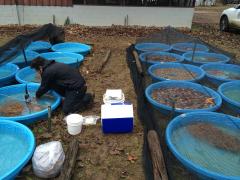
Past research confirms invasive Chinese tallow tree leaves negatively affect the hatching success of leopard frogs and other amphibious species. Ray Montez, an environmental science graduate student at Stephen F. Austin State University, is researching the differences in chemical compositions and decay rates of these leaves, which may contribute to the changes in East Texas’ aquatic microbiological communities, as well as the broader ecosystem. Pictured, Montez extracts a water sample from a mesocosm, a controlled environment that simulates the natural world, containing Chinese tallow leaf litter. Photo courtesy of Dr. Daniel Saenz

Stephen F. Austin State University environmental science graduate student Ray Montez thinks small, microscopically small, in fact.

“For every gram of soil, you can see up to a billion micro-organisms if that soil is healthy,” Montez said.

He added that despite their diminutive stature, the multitude of single-cell organisms that live in the soil, water and air play an integral role in ecosystem function through symbiotic relationships with plants and animals. Each of these micro-organisms has different nutritional requirements; therefore, variations in the chemical composition of their primary medium, such as water, can result in drastic changes to their species composition. This can ultimately affect the broader ecosystem, he said.

Under the direction of Dr. Alexandra Van Kley, SFA professor of biotechnology, and Dr. Daniel Saenz, SFA adjunct graduate faculty member and research biologist with the U.S. Forest Service, Montez is examining the difference between the chemical composition of invasive Chinese tallow tree leaves and the leaves of native East Texas species to determine how those variances may contribute to changes in East Texas’ microbiological communities.

To do so, Montez assembled mesocosms, controlled environments that simulate the natural world. He compared the decay rate of leaves from native species and the Chinese tallow and tracked the chemical changes that occurred in the water as leaf decomposition took place.

“We’re seeing that pH and dissolved oxygen is drastically changed when you introduce these (Chinese tallow) leaves, even for a 24-hour period,” he said.

According to the United States Department of Agriculture, the Chinese tallow was first introduced to the U.S. Gulf Coast in the early 1900s in an attempt to establish a soap industry using the tree’s waxy, tallow-like secretions. Despite the industry’s lack of success, the tree gained popularity as an ornamental species. The species’ extreme reproductive potential and adaptable nature led to its spread across the Southern U.S., in many cases completely altering ecosystems by replacing native vegetation and establishing a monoculture.

Saenz, who grew up on the Texas coast where Chinese tallow has been a species of concern for many years, said that during the past several decades, he has watched the Chinese tallow slowly expand its range into East Texas.

“It’s a big concern,” Saenz said. “It is the fifth most common tree in Louisiana and the fifth most common tree in Texas; so, it’s a serious deal.”

Montez said their experiments show the examined native species leaves contain different chemical concentrations and, in some cases, completely different compounds than Chinese tallow leaves. Furthermore, Chinese tallow leaves decay at a much faster rate in aquatic environments than the foliage of native trees, resulting in a rapid release of nutrients and an upsurge of microbiotic activity.

Previous research conducted by Saenz and SFA’s College of Sciences and Mathematics’ Department of Biology revealed the introduction of Chinese tallow leaves negatively affect the hatching success of leopard frogs and other amphibious species. Further lab investigations by Saenz led him to pinpoint changes that take place in the microbiotic community as the likely source of the drastic shifts in water chemistry.

Montez’s research, which is being funded by the U.S. Forest Service, is a continuation of these initial investigations.

Chinese tallow leaves contain almost double the amount of calcium than native East Texas species, and this might contribute to other microbial species that could dominantly use calcium in their cellular structure, Montez said.

“Microbes are just like you and me,” he said. “They require nutrients to grow, develop and reproduce. They just do it on a faster scale than we do, and because they can reproduce so quickly, they can have a large effect on ecosystem function.”

Montez said they believe microbes rapidly utilize the surplus of nutrients released by the decaying Chinese tallow leaves and set off a series of chemical changes that acidifies the water and depletes it of oxygen. He explained that this is very similar to cultural eutrophication, a form of water pollution by which excess fertilizers and nutrients cause algal blooms that compromise a water body.

To determine which microbes may be responsible for the dramatic change in water quality, Montez ran water samples drawn at different stages of leaf decomposition through filters to preserve for future DNA analysis. Once the microbial DNA is sequenced, Montez will correlate the dominant species with the changes in water quality that occurred over time.

Montez said that recent advances in DNA sequencing now allow researchers to shed light on microbial communities, and this project is one step in better understanding the microscopic communities that shape our ecosystem.

To learn more about this and other research projects in SFA’s Arthur Temple College of Forestry and Agriculture, call (936) 468-3301 or visit atcofa.sfasu.edu.

Posted in All SFA, SFA News | Leave a comment

September 9, 2015: NPD Crime Report

This is a complete list of reports responded to by the Nacogdoches Police Department

This page may take a moment to load.

Click Here to load a separate PDF file

Posted in All Police, NPD Crime Log | Leave a comment

September 9, 2015: Nacogdoches Sheriff’s Crime Log

This is the report from the Nacogdoches County Jail that lists the arrests made from 6 a.m. of the previous day to 6 a.m. of the listed day.

This page may take a moment to load

Click Here to load a separate PDF file

Posted in All Police, SO Crime Log | Leave a comment

September 9, 2015: Nacogdoches County Booking Report

This is the report from the Nacogdoches County Jail that lists the arrests made from 6 a.m. of the previous day to 6 a.m. of the listed day.

This page may take a moment to load

If you are having trouble loading the mugshots please try using a different internet browser

Click Here to load a separate PDF file

Posted in All Police, Booking | Leave a comment

SFA to host Pitcaithley, Woodrow Wilson Visiting Fellow

Stephen F. Austin State University will welcome former National Park Service chief historian Dr. Dwight T. Pitcaithley to campus for a weeklong visit and public address in October.

The Woodrow Wilson Visiting Fellow will present “Centennial of the National Park Service” at 7 p.m. Monday, Oct. 5, in the Baker Pattillo Student Center Grand Ballroom. Admission is free and open to the public.

Pitcaithley said it is a tremendous honor to visit SFA as a Woodrow Wilson Visiting Fellow. “There are dozens and dozens of visiting fellows the university could have selected,” he said. “To spend a week in Nacogdoches interacting with students, faculty, administrators and the public is something I look forward to with great anticipation.”

Students who attend the public address Monday will be entered into a drawing to have lunch with Pitcaithley at noon Tuesday, Oct. 6, at SFA’s Culinary Café. Five students will be selected and their names announced following Pitcaithley’s presentation Monday night.

Dr. Dana Cooper, associate professor in SFA’s Department of History, has assisted in coordinating Pitcaithley’s visit.

“Given the importance of SFA’s Arthur Temple College of Forestry and Agriculture, SFA’s public history program and Nacogdoches being the oldest town in Texas, Dr. Pitcaithley is a terrific fit for both the university and community at large,” Cooper said. “Given the wealth of historical markers, monuments and museums in our city, he will feel very much at home in Nacogdoches.”

In addition to offering thoughts on the future of the National Park Service, Pitcaithley’s address will highlight the history and growth of the National Park Service and its historic preservation programs.

“The National Park Service is much different from what it was at its formation in 1916, not only in size (presently more than 400 parks), but also in congressionally added programs that reach out into every community in the nation,” Pitcaithley said. “These so-called community or preservation programs are immensely important to our society and yet are often not well-known or appreciated.”

Pitcaithley has devoted his life to public history and the preservation of national parks. He began his career 750 feet underground working at Carlsbad Caverns National Park in New Mexico; however, he soon surfaced to become the National Park System’s chief historian for 10 years. As chief historian, he was responsible for the management and preservation of the country’s most-beloved national resources.

“Participating in the restoration and interpretation of the Statue of Liberty and Ellis Island during the 1980s was a highlight of my career, as I was able to work with the leading immigration and ethnic scholars in the country as they embraced their roles as public historians,” he said.

Pitcaithley also was an advocate for high-quality interpretive programs based on current historical scholarship.

“Working on the interpretive exhibits and films for the new information center at Gettysburg National Military Park and interacting with the nation’s most respected Civil War historians was both educational and exciting,” he said. “The National Park Service is an educational organization, so enhancing the interpretive infrastructure of the agency was immensely rewarding.”

Pitcaithley served as president of the National Council for Public History in 1998 and on the editorial boards of The Public Historian and The Journal of American History. He also has published numerous articles and chapters pertaining to public memory, the role of historic sites in public education and the public interpretation of the causes of the Civil War.

In addition to the doctoral degree he earned from Texas Tech University in 1976, Pitcaithley received an Honorary Doctorate of Laws degree from the University of North Carolina in 2011. He is a professor at New Mexico State University and has presented papers in Europe, the United Kingdom, New Zealand and universities throughout the U.S.

“Dr. Pitcaithley has given presentations and lectured around the country,” Cooper said. “He will, no doubt, give a wonderful public address that people of all walks of life and ages can relate to. The creation and protection of national parks is something the broader public cares about.”

Throughout his 30-year career, Pitcaithley has received numerous awards and honors for his work, including the Robert Kelley Memorial Award for the National Council on Public History, the Sequoia Award from the NPS’s Interpretation and Education Program, and the James Madison Prize from The Society for History in the Federal Government.

Woodrow Wilson Fellow Kathleen Kennedy Townsend visited the SFA campus in 2013 through the program that has brought prominent artists, diplomats, journalists and business leaders to campuses across the U.S. for more than 35 years. Through a weeklong residential program of classes, seminars, workshops, lectures and informal discussions, the fellows create better understanding and new connections between the academic and nonacademic worlds.

For more information about the event, contact Cooper at (936) 468-2224.

Posted in All SFA, SFA News | Leave a comment

Daniel, Frields exhibition showing at Cole Art Center

Along with the opening of the Stephen F. Austin State University School of Art Faculty Exhibition on Thursday, Sept. 10, in Cole Art Center will be the opening of a show in memory of two former SFA faculty artists.

“In Memory of Two Former SFA Art Professors: John Daniel & Gary Frields” opens at 6 p.m. in the Reception Gallery in The Cole Art Center @ The Old Opera House. Also opening that night is a show by Shaun Roberts, assistant professor of painting at SFA.

The Daniel show includes digital drawings, prints and mixed media, while the Frields exhibition features digital drawings, traditional drawings and mixed media sculpture. Daniel taught art at SFA for 38 years, and Frields taught for 26.

“The Central theme to Gary’s work was that he had no central theme,” Tamara Robertson, Frield’s widow, said in describing her husband’s work. “He often said he wanted his works to look like a hundred different artists created them, or maybe a mad man, or Bigfoot, or an alien experiencing Earth for the first time.”

In selecting works for the show, Robertson said she primarily tried to find works as different from each other as possible. Frield’s described his own work as: “I begin most works with no attempt to make any particular thing. I proceed relentlessly relying on emotional intuitive reactions while exploring materials, responding as things happen that are not planned. Instinctive discoveries fuel insights while building trust in creating through this working method. This process is suitable to my desire for an unexpected artistic fusion by allowing acquired knowledge and skills to merge with my subconscious as I await whatever might be unveiled.”

“Forms related to Gary’s life would often appear in his work, as he explored the intuitive art-making process,” Robertson said.

Daniel gave the following artist statement in his 2007 catalogue: “I want my art to have the power and appeal of art made by the great primitive societies. I admire the rich vocabulary and the urgency of that art. The objects artists made were of primal importance in people’s everyday life. I want my work to be that intimate. Ideally, the art object would link the viewer to his ancient humanity and to his own personal vulnerability. The art object is a thing, self-contained, finite, but it can be evocative of past feeling and knowledge beyond our comprehension. At the same time, the art object connects the viewer to his own time and space. Sometimes that connecting works best through lightness or humor. Always, it works through what the artist’s hands make.”

These exhibitions and openings are sponsored in part by Friends of the Visual Arts, Nacogdoches Junior Forum and Hampton Inn. Admission is free. All three exhibitions run through Oct. 17. For additional information, call (936) 468-1131.

Posted in All SFA, SFA News | Leave a comment

September 8, 2015: NPD Crime Report

This is a complete list of reports responded to by the Nacogdoches Police Department

This page may take a moment to load.

Click Here to load a separate PDF file

Posted in All Police, NPD Crime Log | Leave a comment