Record Of Criminal Actions taken by Nacogdoches County Court At Law
This is the report of the cases where a verdict was decided.

This page may take a moment to load
Click Here to load a PDF file (1)
Record Of Criminal Actions taken by Nacogdoches County Court At Law
This is the report of the cases where a verdict was decided.
This page may take a moment to load
Click Here to load a PDF file (1)
Agenda for Commissioners Court Tuesday, February 23, 2016
This page may take a moment to load

The Children's Performing Arts Series at SFA will present ArcAttack Science Show at 9:30 a.m. and 12:30 p.m. Friday, March 4, in W.M. Turner Auditorium on the SFA campus.
Described as “the most electrifying science show on tour,” ArcAttack was seen in the fifth season of “America’s Got Talent.” A highlight of an ArcAttack show is the use of two custom-built singing Tesla coils that have been modified to play musical notes.
“Students will explore concepts such as electricity, voltage and current, magnetism, robotics, and lightning through demonstrations and experiments with ArcAttack’s signature Tesla coils, capable of throwing electrical arcs up to 12 feet long,” explains Diane J. Peterson, Fine Arts Box Office manager and director of the children’s series.
The ArcAttack crew and their trusty robot take classrooms on an interactive journey of discovery where students will learn the science behind the amazing display they see on stage. To view a video of the performance, visit www.arcattack.com/
This show targets students in third through 12th grades.
Performances are at 9:30 a.m. and 12:30 p.m. in W.M. Turner Auditorium. Tickets are $7.50 for individuals and $6 per person for groups of 20 or more.
To order tickets, call 936.468.6407 or 888.240.ARTS. Visit the CPAS website at www.cpas.sfasu.edu for additional information.

SFA music faculty members will present "Gen, Jen and Friends" at 7:30 p.m. Tuesday, March 1, in Cole Concert Hall on the SA campus. The performance features, from left, Jennifer Dalmas, violin; Evgeni Raychev, cello; Geneva Fung, piano; Gary Wurtz, trumpet; and Christopher Ayer, clarinet.
Joining pianist Geneva Fung, staff accompanist in the School of Music, will be colleagues Jennifer Dalmas, violin; Christopher Ayer, clarinet; Evgeni Raychev, cello; and Gary Wurtz, trumpet.
Featured on the program are Trio for Clarinet, Violin and Piano by Gian Carlo Menotti; Space Jump for Violin, Cello and Piano, Op. 46 by Fazil Say; and Trio for Trumpet, Violin and Piano by Eric Ewazen.
“Different composers of different nationalities have different perspectives and aesthetics of sound and timber with instrumentation combinations,” Fung said. “I would like to show the different characters and composition techniques through these compositions.”
Italian composer Menotti’s Trio for Clarinet, Violin and Piano was commissioned by The Verdehr Trio, which was formed at Michigan State University. The ensemble premiered the first and second movements at the Spoleto Festival in July 1996, and Menotti promised that the third movement would be ready in time for a concert at Michigan State University, which was to take place in September of that year, Fung said.
“However, administrative duties at Spoleto kept Menotti from completing the piece until the week of the Michigan State premiere,” she said. “He was determined to finish it. In fact, he literally finished the third movement at noon on the very day of the concert.”
A free-fall jump from 39 kilometers above Earth by Austria’s extreme sportsman Felix Baumgartner in 2012 inspired Turkish-American composer Say’s Space Jump for Violin, Cello and Piano, Op. 46, according to Fung.
“In his musical illustration of this revelatory voyage from space to Earth, Say depicts each phase of the jump, from takeoff to safe landing,” Fung said. “Say’s intense fascination with this event prompted a work containing every emotion he experienced as a spectator.”
In Trio for Trumpet, Violin and Piano, Ewazen “uses the trumpet heroically and dramatically, but at the same time lyrically,” Fung explained. “Each of the four movements in this composition demonstrates different timbre and color of the uncommon instrumental combination.”
The recital is a joint presentation of the SFA College of Fine Arts and School of Music and is a feature of the Cole Performing Arts Series.
Tickets are $8 for adults, $6 for seniors and $3 for students and youth. For tickets or more information, call the SFA Fine Arts Box Office at (936) 468-6407 or visit www.finearts.sfasu.edu.
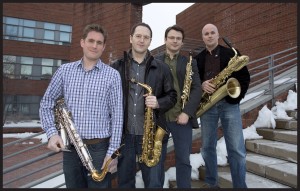
The Oasis Quartet will perform at 7:30 p.m. Friday, Feb. 26, in Cole Concert Hall on the SFA campus.
“The music on this program represents some of our favorite works for saxophone quartet and actually features two new pieces written for Oasis Quartet,” said Dr. Nathan Nabb, professor of saxophone in the SFA School of Music and quartet member. Other members include James Bunte, Dave Camwell and James Romain.
“We put a great deal of thought into our programs and always plan to present an exciting blend of original works for the instrument as well as transcriptions from varying periods and styles,” Nabb said. “This approach leads to a diverse program with something for every listener and allows us to show the flexibility of the instrument and ensemble.”
“Scallywag” is a new work Stephen Lias, professor of composition at SFA, wrote for Oasis last spring. Oasis premiered it this past November during the ensemble’s fall tour of the Midwest.
“This is a challenging work that blends elements of jazz and funk with more traditional ‘classical’ saxophone techniques,” Nabb said. “Steve has collaborated with Oasis on various projects for over five years now, and he certainly knows the strengths of the group. The result is a really fun and energetic concert opener.”
Also on the program is “Recitation Book” by David Maslanka, which is a work that became popular in the saxophone quartet repertoire in the early 2000s, according to Nabb.
“Like much of Maslanka’s music, this work draws from various musical periods, including madrigals, chorales and chant,” he said. “The fifth movement, ‘Fanfare and Variations on Durch Adam’s Fall,’ is a powerful and virtuosic closer to the piece and stands alone as a work unto itself in this program.”
Also featured will be a piece by Dutch composer and saxophonist Guillermo Lago, founding member of the Aurelia Saxophone Quartet, and another piece written specifically for Oasis by Richard Lavenda, professor of composition and theory at Rice University.
Each member of Oasis is a concert artist in his own right, and they appear regionally, nationally and internationally as chamber musicians, clinicians, orchestral musicians, solo recitalists and adjudicators. They can be heard on the Teal Creek, Centaur, Innova, Amp Recordings, and Mark Custom labels, and in performances with the St. Louis Symphony Orchestra, the Cincinnati Symphony Orchestra, the Minnesota Orchestra, as well as a number of regional orchestras.
Tickets are $8 for adults, $6 for seniors and $3 for students and youth. For tickets or more information, call the SFA Fine Arts Box Office at (936) 468-6407 or visit www.finearts.sfasu.edu.
The Department of Human Services and the Center for Digital Scholarship at Stephen F. Austin State University recently published the first edition of the Journal of Human Services: Training, Research, and Practice.
This online, peer-reviewed journal publishes reviews and articles based on research, theory development, case studies, and program and intervention applications.
The journal’s mission is to provide practitioners and educators with a forum to report data that substantiate current practices or raise questions about mainstream thinking and practices in education and service delivery within disciplines specifically related to human services.
Dr. Robbie Steward, chair of the Department of Human Services at SFA and the journal’s executive editor, began working on the project in 2014.
“One goal I have maintained is facilitating not only faculty members’ engagement in research and scholarship, but also providing guidance in encouraging undergraduate, graduate and doctoral student participation,” Steward said. “The journal offers a nice balance because it keeps students interested in research and encourages them to collaborate with faculty members in the research process.”
The first issue featured five articles with topics ranging from social work to system changes in education. SFA students from the visual impairment and school psychology programs served as co-authors on three of the published articles. To view the journal, visit http://scholarworks.sfasu.edu/jhstrp/.
“The journal provides another forum for students and faculty members to enhance their professional development and it gives them an opportunity to add to the literature related to their specific disciplines,” Steward said.
The journal’s multidisciplinary nature allows for the consideration of a range of manuscript types. Also, the educational and comprehensive feedback distinguishes it from many other publications.
“Our review process has an educational component beyond the typical accept, reject or revise outcome. All authors receive detailed and comprehensive feedback from discipline-associated editorial board members regarding how to strengthen the submitted manuscript regardless of the final decision,” Steward said.
The journal’s editorial board is comprised of professionals experienced in various human service-related disciplines from many locations, including South Korea, New Hampshire, Michigan, Georgia and Florida.
“The diversity of the editorial board enhances the journal’s quality and validates the source of the feedback and investment of the editorial board members. This special attention to each manuscript is provided as an educational component for students and faculty members who are beginning their careers as academicians,” Steward said.
The journal will be published twice a year with special issues approved by the editorial board. Students and faculty members working in any field can submit articles to the journal for review.
Steward believes the research opportunities and experience this journal will afford students will be valuable for their careers.
“School is not just about course enrollment and degree completion; it’s about preparing for a career,” Steward said. “Publications and presentations at conferences will help distinguish SFA students from others because these added experiences document our students not only know what they are doing and the reasons for their practices, but also are familiar with the literature and the process of inquiry and critical thinking within their disciplines.”
For more information, contact Steward at stewardjr@sfasu.edu.

This is a complete list of reports responded to by the Nacogdoches Police Department
This page may take a moment to load.

This is the report from the Nacogdoches County Jail that lists the arrests made from 6 a.m. of the previous day to 6 a.m. of the listed day.

This page may take a moment to load
This is the report from the Nacogdoches County Jail that lists the arrests made from 6 a.m. of the previous day to 6 a.m. of the listed day.

This page may take a moment to load
If you are having trouble loading the mugshots please try using a different internet browser
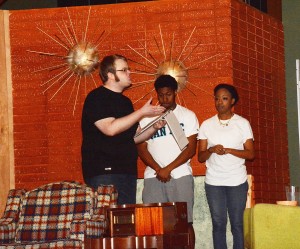
SFA theatre student Robert Malbrough, left, standing in as the character of Karl Linder, rehearses with fellow actors Terrance Simon and Jonee Lewis in a scene from "Clybourne Park." The School of Theatre will present the Bruce Norris play at 7:30 p.m. Tuesday through Saturday, Feb. 23 through 27, in W.M. Turner Auditorium on the SFA campus. Photo courtesy of The Pine Log.
Those observations by Dr. Dianne E. Dentice, associate professor of anthropology, geography and sociology at Stephen F. Austin State University, show us that the racial themes addressed in the upcoming SFA School of Theatre’s production of “Clybourne Park,” despite improvements, are as timely today as they were at the height of the Civil Rights movement.
“The overall state of race relations in the U.S. is slowly improving, but we still have a long way to go,” Dentice said. “Poverty, urban decay, job and wage stagnation, and education inequality continue to have devastating consequences for young African Americans, especially males.”
The School of Theatre will present “Clybourne Park” by Bruce Norris at 7:30 p.m. Tuesday through Saturday, Feb. 23 through 27, in W.M. Turner Auditorium on the SFA campus.
Winner of the 2011 Pulitzer Prize for drama, “Clybourne Park” was written in response to the classic “A Raisin In the Sun.” In “Raisin,” an African American family in 1959 Chicago is moving to a white neighborhood, Clybourne Park. The first act of the newer play is set on the same day as one scene in “Raisin,” in the house that the family is buying. The second act is set in the same house 50 years later, with the tables turned – a white family now seeks to buy the house from a black family.
One of the main issues in “Clybourne Park” is the effect that an influx of new residents from a different racial group has on a community and, in particular, on its economics. The play highlights the concern a white homeowner (Mr. Linder) has in 1959 that new African American homeowners will lower his property value and the fears of the African American residents 50 years later who are concerned about an influx of white families and the resulting gentrification.
“Unfortunately (in my opinion), Mr. Lindner’s concerns/opinions about neighborhood integration have not gone away,” Dentice said. “Even though things have gotten somewhat better over the last 50 years, surveys of the American public reveal that African Americans, Native Americans, Hispanic Americans, and gay men are seen as less competent than their white counterparts. One fact cannot be disputed, and that is that African Americans are still the most segregated minority group in the United States.
“Gentrification continues to be a reality – especially in urban areas like Philadelphia,” she said. “It does not always affect only African Americans, however. In cities like San Francisco, middle class white professionals are being displaced by newly minted high tech millionaires. The reality of the situation is that progress is not going to be halted by cities that are struggling to meet their budgets. Poor and working families will continue to be locked out of housing opportunities because they just cannot afford the increased rent that comes with structural improvements initiated by new owners.”
For student actor Terrance Simon, junior theatre major from Houston, the issues addressed in “Clybourne Park” “hit pretty close to home,” he said.
“The conflicts are all too real,” Simon said. “I personally live in a neighborhood that is being gentrified, and I have seen childhood friends have to move out of their homes.”
Another theme in the play addresses “racial anxiety,” or the way the characters communicate sensitively yet directly about race, culture and gentrification. Dentice said many of her students are not fully aware of the history of the civil rights movement and the struggle people went through during those years.
“Even though the content of my classes is often uncomfortable for students of all races and ethnicities, they have to become aware that prejudice, stereotyping and discriminatory practices are still a reality in our society and others,” she said. “It is my responsibility, however, to present the material and discuss how things have changed but still remain the same with regard to racial profiling and mass incarceration of African Americans.
“I think that Americans would like to believe that racial strife is a thing of the past,” Dentice continued. “Some Americans think that there is nothing else to be done and our society is post-racial. A really inconvenient fact is that our country has the highest prison population rates in the world. The majority of prisoners are poor males, many of whom are black.”
The U.S. represents 5 percent of the world’s population and 25 percent of the world’s prison population, according to Dentice.
“It is a costly system that is largely ineffective with high recidivism rates across the board,” she said. “Until we begin to deal with all the variables that cause crime – poverty, decaying inner city schools, high dropout rates and lack of opportunity for minority youth – we will continue to have racial disparities in the criminal justice system that are largely an American phenomenon.”
Simon believes that the play demonstrates “the need for Americans, who live in possibly the most privileged country in the world, to sit down and have true heart-to-heart conversations and stop shunning the subject.”
“With that being said, Bruce Norris has written some brilliant dialogue in this dark comedy,” Simon said. “There is nothing better than going to the theater and getting your own interpretation, and I hope people leave wanting to speak more intellectually on the subject.”
“I think one of the lessons you can take from this play is how to consider social issues from all sides,” said fellow actor Jonee Lewis of Allen, “and how to go about it in a way where you raise awareness and are heard without spewing ignorance. As far as the race discussion, I believe that we have made some progress. I also think that the discussion of race relations will always be uncomfortable, but not impossible.”
Can heightened discussion about race, or even movies or plays like “Clybourne Park,” help to improve race relations?
“I think that the arts can provide positive avenues for open debates about race and other social issues, such as mass incarceration and poverty,” Dentice said. “Plays like ‘A Raisin in the Sun’ and ‘Clybourne Park’ represent different perspectives that were overlooked for many years prior to the Civil Rights movement. Writers like James Baldwin, Lorraine Hansberry and Toni Morrison, among others, not only gave us great literature and play writing, but they also made us think about who we are as a country and what is important to move us forward. They are some of the giants – in my opinion.
“The challenge for our contemporary society is to continue elevating the discussion surrounding race relations in post-Obama America and be really careful not to fall victim to cliché and innuendo.”
Audiences of “Clybourne Park” will not only learn more about race relations, but they will also see examples of “why we as Americans have failed at this subject,” Simon said.
“I believe that Bruce Norris couldn’t have written more realistic people,” he said. “Every single character in this show fails to achieve their goal, and I believe this happens because we all have our minds set on what we believe, and no one wants to actually sit down and listen to what the other is saying.”
Zach Hanks, assistant professor of theatre at SFA and the play’s director, agrees with the premise that plays like “Clybourne Park” are important to perform to keep the discussion on race relations moving forward.
“Pointing out a flaw in another person’s thinking is usually far less persuasive than showing it to them,” Hanks said. “This is why plays like ‘Clybourne Park’ aren’t just important, but are profoundly necessary.”
“Hard data, incontrovertible facts and ironclad arguments not only fail to change people’s minds, they often make those people dig in and double down on the positions they already hold,” Hanks said. “However, show an audience an injustice, make them sit helplessly and bear witness to the pain it causes human beings, and you can effortlessly make people change their minds and clamor to change their world, because you did it by way of their hearts.”
“Clybourne Park” features mature themes, suggestive dialogue, and very coarse language, including some profanity, which may not be suitable for younger audiences. Cigarette smoking is simulated in the production. In other media, this show might be rated “R” or “TV-MA.”
Single tickets are $15 for adults, $10 for seniors and $7.50 for students/youth. For tickets or more information, call the SFA Fine Arts Box Office at (936) 468-6407 or visit www.finearts.sfasu.edu. Tipton-Ford-Lincoln is an annual sponsor of the School of Theatre’s Mainstage Series.