
This is a complete list of reports responded to by the Nacogdoches Police Department
This page may take a moment to load.
This is a complete list of reports responded to by the Nacogdoches Police Department
This page may take a moment to load.

This is the report from the Nacogdoches County Jail that lists the arrests made from 6 a.m. of the previous day to 6 a.m. of the listed day.

This page may take a moment to load
This is the report from the Nacogdoches County Jail that lists the arrests made from 6 a.m. of the previous day to 6 a.m. of the listed day.

This page may take a moment to load
If you are having trouble loading the mugshots please try using a different internet browser
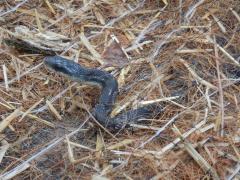
Researchers from Stephen F. Austin State University’s Arthur Temple College of Forestry and Agriculture and the U.S. Forest Service received a highly-sought-after Texas Parks and Wildlife Department grant explicitly focused on wildlife conservation. Dr. Chistopher Schalk, SFA assistant professor of forest wildlife management, and Dr. Dan Saenz, U.S. Forest Service research biologist, are investigating the effect of erosion control materials on snakes with the overall goal of reducing snake mortality. The grant is funded through TPWD’s Conservation License Plate Program. Pictured, a Western ratsnake is seen entangled in erosion control material during a field survey conducted by U.S. Forest Service field technicians. These erosion control devices are commonly used along roadsides during construction projects. Photo credit: Sarah Ebert
Each year, the funds generated through the purchases of a Wild for Texas Collection license plate enable the agency to finance yearly grants explicitly focused on wildlife conservation.
This year, Dr. Christopher Schalk, assistant professor of forest wildlife management at Stephen F. Austin State University’s Arthur Temple College of Forestry and Agriculture, and Dr. Daniel Saenz, research biologist with the U.S. Forest Service, received one of these highly sought-after grants and are currently investigating the effect of erosion control materials on snakes.
Layers of woven mesh mats made of varying materials are often used as erosion control devices during construction along Texas’ roadways, but little is known about their impact on wildlife species susceptible to entanglement in the mats.
“A lot of the documented deaths have been anecdotal observations,” Schalk said. “No one has done consistent surveys or entanglement trials to determine which products are more dangerous to snakes.”
Prior to launching their research, U.S. Forest Service field technicians surveyed locations in Houston County where erosion barriers were utilized.
“We found 10 snakes of four different species entangled, and seven were dead,” Schalk said. “The thing is, it was not that large of an area where these barriers were deployed.”
The scale of potential snake mortality becomes quite clear when one considers the miles of erosion control mats used alongside road construction throughout Texas and the United States, including areas adjacent to habitat of federally threatened species, such as the Louisiana pine snake.
“The troubling thing that we’re finding is that larger snakes, which are the adults, are more prone to getting entangled,” Schalk said. “That’s not a good thing for their population viability.”
During the field surveys, technicians found two gravid females, each containing more than 20 eggs, that had become entangled and died in the mesh netting.
“It’s a really a brutal death and a sad thing to see,” Saenz said.
To shed light on which style of erosion control netting is least likely to entangle snakes, Schalk and Saenz are conducting field trials with three commonly used erosion control mats.
The team places a captured snake in an enclosure with one style of erosion control mat covering a portion of the area. The snake is then observed as it traverses the material for up to three minutes. If the snake becomes entangled, it is documented and immediately removed.
Schalk said that so far it appears the erosion control mat constructed of woven natural fibers appears to be the least likely to cause ensnarement, but data analysis is necessary to confirm this observation.
“Unlike the polypropylene mesh mats, the corners of the woven coconut fiber mats are not fixed,” Schalk said. “This provides a lot more flexibility in terms of animals passing through.”
Ultimately, the researchers hope to share their findings with the Texas Department of Transportation, the state agency responsible for numerous large and complex transportation projects that require the use of erosion control mats.
“A TPWD Conservation License Plate Grant enables us to conduct proactive research that helps identify the potential factors that may threaten a wildlife population,” Schalk said. “Results from this research can help develop strategies to help conserve Texas wildlife.”
To learn more about how you can support wildlife conservation and research like this, visit the Texas Conservation License Plate Program at conservationplate.org.
Story written by Sarah Fuller, outreach coordinator for Stephen F. Austin State University’s Arthur Temple College of Forestry and Agriculture.
This is a complete list of reports responded to by the Nacogdoches Police Department
This page may take a moment to load.
This is the report from the Nacogdoches County Jail that lists the arrests made from 6 a.m. of the previous day to 6 a.m. of the listed day.
This page may take a moment to load
This is the report from the Nacogdoches County Jail that lists the arrests made from 6 a.m. of the previous day to 6 a.m. of the listed day.
This page may take a moment to load
If you are having trouble loading the mugshots please try using a different internet browser
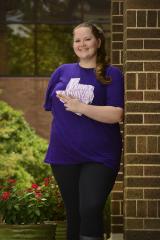 Just one year and a day after the traumatic car accident that resulted in the amputation of Marissa Rotenberry’s right arm, she recently walked the stage at Johnson Coliseum and received her diploma for a master’s in statistics.
During her extended hospitalization following the accident, she had a singular focus pushing her through recovery – finishing her degree.
“It was very traumatic, but it didn’t change me,” Rotenberry said, “and it didn’t have to change my goals.”
Set to start her final semester of graduate school, her plans came to a temporary standstill on Aug. 10, 2017, when she was involved in the accident.
Sitting in the backseat with her arm near the window, Rotenberry took the brunt of the impact when the car crashed. Her arm was mangled by glass, and she sustained other severe injuries, including a lacerated liver, fractured discs and an internal chest degloving (an injury occurring when the skin separates from the muscle).
“I remember being in and out of consciousness,” she said. “I was never confused about what was going on, and I was very aware I had been in a bad car accident.”
Paramedics rushed Rotenberry to Nacogdoches Memorial Hospital and then transported her to Ben Taub Hospital in Houston, where doctors decided to amputate her arm. She remained there for 34 days.
With her extensive injuries, she took recovery one day at a time and celebrated every small victory.
“I remember the second day I was there, they had me sit up in a chair, and I got applauded,” she said.
Rotenberry went through occupational therapy and had three surgeries each week to tend to her wounds.
“It wasn’t until day 33 I knew I was leaving,” she said.
Less than three months after the accident, Rotenberry returned to school.
“I was only one semester away from graduation, so there was no doubt in my mind I wanted to finish it,” she said. “Grad school is hard work. It would essentially be throwing away the time I already put in, and that just seemed crazy.”
Because she started back in the middle of the semester, her professors customized the remaining part of her degree plan to give her time to study while focusing on healing. Working with Rotenberry was the department’s way of repaying her faith in the university, said Dr. Greg Miller, professor of statistics.
“She has entrusted all of her higher education to us, so we said, ‘What are we going to do about it? What’s the best way to chart a course for her?’” Miller said. “It was not an obligation but a real desire to do right by somebody.”
With the faculty’s help, Rotenberry planned on graduating in May until an infection required additional surgeries and pushed it back to August. Even after the set-back, she continued working toward graduation.
“After you teach for a while, you get good at recognizing talent, but the things you really can’t coach up in people are intangibles,” Miller said. “It’s the resilience. It’s the perseverance. It’s the stick-to-it, dedicated type of attitude that describes Marissa.”
While there have been many challenges on the road to recovery, the biggest change has mostly been mental, Rotenberry said.
“Sometimes it’s easy to forget because I still feel my hand,” she said. “Sometimes I feel like I want to grab things or use it. It’s just that adjustment, always.”
Whatever comes next, Rotenberry remains positive she can overcome any obstacles thrown her way.
“The bigger challenge would have been if I didn’t have any arms,” she said. “You can persevere, and you can keep going. It didn’t have to stop me.”
By Joanna Armstrong, senior marketing communications specialist at Stephen F. Austin State University.
This is a complete list of reports responded to by the Nacogdoches Police Department
This page may take a moment to load.
This is the report from the Nacogdoches County Jail that lists the arrests made from 6 a.m. of the previous day to 6 a.m. of the listed day.
This page may take a moment to load