
This is the report from the Nacogdoches County Jail that lists the arrests made from 6 a.m. of the previous day to 6 a.m. of the listed day.

This page may take a moment to load
This is the report from the Nacogdoches County Jail that lists the arrests made from 6 a.m. of the previous day to 6 a.m. of the listed day.
This page may take a moment to load
This is the report from the Nacogdoches County Jail that lists the arrests made from 6 a.m. of the previous day to 6 a.m. of the listed day.

This page may take a moment to load
If you are having trouble loading the mugshots please try using a different internet browser
Record Of Criminal Actions taken by Nacogdoches County Court At Law
This is the report of the cases where a verdict was decided.

This page may take a moment to load
NPD Crime Report
This is the report from the Nacogdoches County Jail that lists the arrests made from 6 a.m. of the previous day to 6 a.m. of the listed day.
This page may take a moment to load
If you are having trouble loading the mugshots please try using a different internet browser
This is the report from the Nacogdoches County Jail that lists the arrests made from 6 a.m. of the previous day to 6 a.m. of the listed day.
This page may take a moment to load
This is the report from the Nacogdoches County Jail that lists the arrests made from 6 a.m. of the previous day to 6 a.m. of the listed day.
This page may take a moment to load
If you are having trouble loading the mugshots please try using a different internet browser
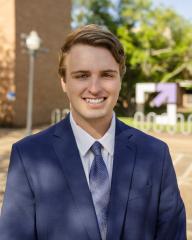
Stephen F. Austin State University marketing senior Grant Lebkowsky of Flower Mound secured a job at Mustang Cat in Houston before he graduated by taking advantage of corporate partnerships through SFA’s Rusche College of Business.
Lebkowsky started his new job at Houston’s Mustang Cat headquarters two weeks after graduating with his Bachelor of Business Administration in marketing this May. Mustang Cat is a privately held Cat dealership that has offered construction and power systems equipment for 70 years.
“Before attending SFA, I had heard of Caterpillar products but not the specific Cat dealer in the Houston area,” Lebkowsky said. “This job opportunity wouldn’t have been on my radar if it wasn’t for the College of Business’s partnership with Mustang Cat. The partnership made the process so much less nerve-wracking, and it allowed me to interview in a familiar environment.”
Lebkowsky learned about Mustang Cat because of the college’s Mustang Cat Day, when representatives from the company visit with SFA business students to discuss their interests and the company’s needs to see if they align. Turns out, Lebkowsky and Mustang Cat were a match.
“They have a developmental management and sales training program that offers opportunities to learn how to properly support prominent customers and improve operations,” Lebkowsy said. “I’ll work with Cat to overcome supply chain logistic issues, manage customer accounts and payment, and partner with strategic teams to meet critical success factors. I am very excited to learn how to handle the new challenges this job will present.”
The college’s corporate partnerships also give students access to a variety of companies through the annual College to Career conference and the Career Success Passport Program. These are managed by Gina Small, academic advisor, career success specialist and lifesaver to many students in the College of Business.
“When I work with students to help them move from the theoretical ‘future career’ to concrete strategies and opportunities, that light comes on, and they make that connection — their excitement is so tangible,” Small said. “They can see a path forward and understand it’s something at which they are capable of succeeding. They bridge that gap between student and ‘real adult’ and gain that confidence to move forward.”
In addition to job search assistance, the Career Success Passport Program offers scholarships for students who participate in personal and professional branding, experiential learning, leadership development, and cocurricular events and activities throughout their college years.
Small said most students are apprehensive during their job searches, but using the college’s career resources creates “a large measure of relief. Grant is a great example of a student who listened and reached out at the right time, and things came together for him.”
Small hosts presentations a week before events like Mustang Cat Day to prepare students and settle nerves.
“These give students information on what to expect and how to conduct themselves,” Lebkowsky said. “They were a huge help.”
During one of these sessions, Lebkowsky met Mustang Cat representatives and learned more about the company so that by the time Mustang Cat Day rolled around, he was ready.
“I interviewed with their team, and the whole experience was amazing,” he said. “It was awesome to not have to drive all the way to Houston for an interview or do a Zoom interview. It made the job search process way easier.”
Austin Propes, general service manager at Mustang Cat in Houston, credits the College of Business with facilitating “seamless interaction with students.”
“Through in-classroom conversation, college to career messaging and on-location interviews, we’ve found individuals like Grant Lebkowsky,” Propes said, adding that working with the college’s corporate partnership program has helped the company find the talent it needs.
Lebkowsky isn’t the only Lumberjack at his new job. SFA alumna Seraiah Scamardo, who earned a Bachelor of Business Administration in economics in 2018, is now the parts department manager at Mustang Cat in Houston and will be supervising Lebkowsky.
To learn more about the College of Business, visit sfasu.edu/cob.
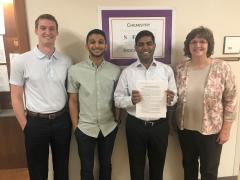
Dr. Matibur Zamadar (holding patent), Stephen F. Austin State University associate professor in the Department of Chemistry and Biochemistry, received a patent from the U.S. Patent and Trademark Office for his invention regarding therapeutic treatment of bacteria and cancers, and fluorescence diagnosis. He is pictured with SFA undergraduate students (from left) Jacob Herschmann and Aqeeb Ali, and Dr. Michele Harris, associate dean and professor in the Department of Chemistry and Biochemistry.
Zamadar’s invention relates to methods and compositions for therapeutic treatment to slow or stop the progression of bacteria and cancers, and fluorescence diagnosis.
“Traditional cancer treatments, such as surgery, radiation and traditional chemotherapy, have limitations,” Zamadar said. “In general, these treatments lack selectivity for removing or killing malignant tumor tissues and are costly, highly invasive and/or administer toxic treatments.”
Zamadar said studies project worldwide cancer-related deaths will increase 70% by 2040. With cancer-related deaths on the rise, there is a need for improved, nontoxic, noninvasive, low-cost, effective cancer therapy methods enabled by compositions that can be readily prepared without specialized costly synthesis equipment or extensive training.
“This invention relates to multifunctional treatment compositions and methods that can potentially help cure many types of cancer,” Zamadar said. “Our data suggest the invention is very effective at producing reactive oxygen species and nontoxic chemotherapeutic agents in various cancerous cell environments, such as aerobic, anaerobic or H2O2-rich environments in the presence of or absence of light,” Zamadar said.
The invention’s significant advantage is it enables portable treatment and diagnosis under differing field conditions using kits prepared from commercially available materials. These kits can be easily stored, readily transported without activation, and then activated, as needed, at remote treatment sites, such as those in developing countries.
“It generates on-site one or more reactive oxygen species and a nontoxic chemotherapeutic agent selected from the group comprising singlet oxygen, hydroxyl radical, chemotherapeutic agent Juglone, or its derivatives, or combinations thereof,” Zamadar said. “This suggests that a single composition kills cancer cells via multiple mechanisms within a short treatment time, typically minutes. The composition is only effective against cancer cells. It is nontoxic to healthy cells at a low-dose level and can be used multiple times with no side effects.”
Zamadar began the patent application process in 2018. This is the first patent granted to a professor in SFA’s College of Sciences and Mathematics within the Department of Chemistry and Biochemistry.
“The patent would not have been possible without support from SFA faculty members and students,” Zamadar said. “Dr. Michele Harris, associate dean and professor in the Department of Chemistry and Biochemistry, and undergraduate students, Aqeeb Ali and Jacob Herschmann, provided technical support throughout the patent process, and retired patent attorney Tom Pruitt provided his expertise to file the patent application.”
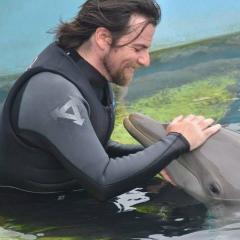
Dr. Jason Bruck, Stephen F. Austin State University assistant professor of biology, recently published a study that sheds light on how dolphins use taste and signature whistles to identify each other. Bruck conducted much of his research at Dolphin Quest in Bermuda, where he is currently spending part of the summer building upon his study.
The study offers two findings:
1. Dolphins can recognize each other using urine cues, similar to how dogs sniff urine left by other dogs. But, since dolphins cannot smell, they make the identification by taste. According to Bruck, dolphins are the first vertebrate to do this, and it offers a new way to study how vertebrates identify each other through gustatory (taste) mechanisms.
2. Dolphins use signature whistles (individual acoustic calls that dolphins invent during the first year of life) in much the same way humans use names. When a dolphin hears a signature whistle, it pictures the dolphin that “owns” that whistle. This is the first time a nonhuman has been shown to use an innovated and learned acoustic label the way humans use names.
Bruck’s father is a veterinarian, and his mother was a wildlife rehabilitator in upstate New York. Since Bruck grew up around animals, it made sense that he wanted his career to focus on animals, too. By the time he was 3, Bruck knew, “I was going to be a whale or dolphin doctor. Over time, I realized I was more interested in the science of what and how animals do what they do, rather than just the straight medical aspects of whale biology.”
Trips to SeaWorld and watching fiction shows like “SeaQuest DSV” in the early 1990s led Bruck to pursue a career as a dolphin behavioral biologist focusing on dolphin communication and cognition.
Bruck graduated with his doctoral degree in behavioral biology from the University of Chicago in 2013. He has received numerous grants, authored and coauthored dozens of publications, and served as a faculty advisor/mentee to several graduate and undergraduate students. He formerly served as a visiting assistant professor of zoology and teaching assistant professor of integrative biology at Oklahoma State University and as a former Marie Curie Research Fellow at the University of St. Andrews in Scotland, United Kingdom.
His recent research involving dolphins began in 2016 through a grant from the Marie Sklodowska-Curie Fellowship of the European Commission. Bruck has conducted much of this research at Dolphin Quest in Bermuda, Oahu and Hawaii. These facilities offer their guests the opportunity to view, meet and experience dolphins in sheltered, natural ocean lagoon settings while supporting vital marine mammal conservation, education and scientific study.
Bruck conducts his research above water using specialized equipment, such as underwater speakers and hydrophones. And although the research has provided scientists with important information about how dolphins identify each other and communicate, it also has implications for humans.
“It is likely that dolphins use a lipid taste receptor to identify urine cues in their fellow dolphins,” Bruck said. “The gene that codes for that is called CD36. Most humans also have this gene, and it helps them determine when they have had enough to eat. Humans lacking it are at higher risk for obesity. It is possible that dolphins can offer a better way to study the molecular anatomy of CD36 to help better understand how it works in people.”
Bruck’s research regarding signature whistles piggybacks off discoveries made in the 1960s in Florida in which dolphins were shown to make different sounds when they were separated from members of their group.
“Dolphins don’t have ‘voices’ because the pitch of their calls change as they dive deeper,” Bruck said. “Past research shows that dolphins can use each other’s whistles to address individuals. My previous research has revealed that dolphins can remember these whistles for 20 or more years, and now we know they probably use them the way humans use names for recognition.”
Bruck said this portion of his research is complete, but he is back in Bermuda for part of the summer to build upon it.
“We are moving forward with signature whistle playback experiments to determine how different social relationships may be perceived in dolphin community ecology,” Bruck explained. “Something else we might investigate down the road is how commercial and industrial chemicals might affect urine cuing in dolphins. We may find that oil spills, chemical runoff and other human effects can impede the dolphins’ natural ability to chemically signal to one another. This might prevent males from identifying reproductively capable females or diminish dolphins’ abilities to recognize individuals through honest signals.”
Read more about this study at www.science.org/doi/10.1126/sciadv.abm7684.
Registration is underway for Junior Jacks Theatre Camp at Stephen F. Austin State University. The popular two-week School of Theatre camp is designed for children entering third through ninth grades. This year’s camp is scheduled for Monday through Friday, July 25 through 29, and Aug. 1 through 5, with play performances on Saturday, Aug. 6.
Junior Jacks was designed as a day-camp version of the highly successful High School Summer Theatre Workshop at SFA, according to Carolyn Conn, professor of theatre at SFA and the camp’s director. The fun and exciting summer camp, offered in two age groups, fills quickly, and Conn suggested parents register their children early.
“We have children representing all local and nearby schools as well as many home-schooled children,” Conn said. “There are also many repeat campers. Many Junior Jacks ‘graduates’ go on to attend the High School Summer Theatre Workshop at SFA. We also have former Junior Jack/High School Workshop participants who become theatre majors at SFA. The camp is a great introduction to what we offer in the School of Theatre.”
The camp has expanded its capacity in recent years, so more students can participate, Conn said.
“As the School of Theatre’s teacher certification program grows and has incorporated the camp into its ‘Directing for the Youth’ course, we have a large number of student directors available to work with the children,” she said. “Additional teachers mean we have room for additional campers! So, we are aiming for another increase in campers this year.”
Junior Jacks is a community outreach opportunity designed to not only introduce children to theatre, but it also allows the School of Theatre’s teacher certification students to work with students who are younger than high school age. Junior Jacks campers play theatre games and rehearse plays that will be performed at the camp’s conclusion.
Registration cost is $85 per student and $60 for each additional sibling within a single family. Needs-based scholarships may be available. The camp is co-sponsored in partnership with Nacogdoches Arts Collaborative. More information and a registration form can be found at theatre.sfasu.edu, or contact Conn at (936) 468-1031 or conncs@sfasu.edu.