Dr. Paula Griffin receives Texas Project Learning Tree award for leadership in education
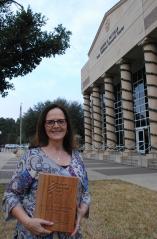
Dr. Paula Griffin, an associate professor in Stephen F. Austin State University’s Department of Elementary Education, received the 2019 Leadership in Education Award from Texas Project Learning Tree in October. Sponsored by Georgia-Pacific, the award honors those who make significant contributions to advance PLT programs and initiatives at the state or regional level. Griffin will represent Texas at the national PLT award level in late 2020.
A decade later, thanks to a lot of work and dedicated mentors along the way, Griffin has turned that limitation into an award-winning strength and is helping SFA teacher candidates do the same.
An associate professor in SFA’s Department of Elementary Education, Griffin received the 2019 Leadership in Education Award from Texas Project Learning Tree in October.
Sponsored by Georgia-Pacific, the award honors those who make significant contributions to advance PLT programs and initiatives at the state or regional level. Griffin will represent Texas at the national PLT award level in late 2020.
Since 1976, PLT, the environmental education program of the Sustainable Forestry Initiative, has reached 138 million students and trained 765,000 educators to help students learn “how to think, not what to think, about complex environmental issues,” according to the PLT website.
“I wholeheartedly believe in PLT and its structure and background,” Griffin said. “PLT made sense to me because I support and follow the constructivist learning theory.”
At its heart, this theory suggests that humans construct knowledge and meaning through experiences.
“When we’re learning, we create new schema and new ideas, and we fit those in with what we already know,” Griffin said. “As we interact with our environment, in and out of the classroom, we add to our store of understanding and knowledge.”
Griffin is a Triple Jack, meaning she earned her bachelor’s degree in elementary education, master’s degree in early childhood education and doctoral degree in educational leadership all from SFA.
“I completed my bachelor’s in three years because I just loved my elementary education classes,” she said. “I’d take 18 and 21 hours a semester. I couldn’t get enough.”
During these three years, Dr. Janice Pattillo, former chair of the Department of Elementary Education and the namesake of SFA’s Janice A. Pattillo Early Childhood Research Center, was Griffin’s advisor, mentor and teacher for many classes. Griffin was a student assistant at SFA’s Early Childhood Laboratory from 1979 to 1981 before getting her first job there as a toddler teacher.
In 1985, Griffin taught in Garrison before joining the Nacogdoches Independent School District in 1986. She was one of the two teachers who started NISD’s pre-K program. In 2002, she left the public school classroom.
Then Pattillo recruited Griffin to teach at SFA. As an adjunct professor of elementary education in 2006, Griffin took on the role of grant coordinator for the department. In 2009, she accepted a tenure track position, and, from 2014 to 2017, she coordinated the early childhood through sixth grade, or EC-6, online completer program for the Department of Elementary Education.
“They’re called completers because they’ve started coursework at a community college, usually several years ago, took a break and then decided they want to come back,” Griffin said. “They are focused and ready to finish their education.”
Griffin admitted, advised and taught completers every semester. Even before then, as grant coordinator, she worked on partnerships with community colleges to help ensure the completers could seamlessly transition into their coursework at SFA. Today, she continues to champion these students.
In 2010, when she began working on her doctoral degree, Griffin chose the outdoor education activity Bugs, Bees, Butterflies and Blossoms as one of her internships to help reverse her science deficit.
“I had a fantastic colleague and mentor here named Dr. Alan Sowards, and I knew he hosted this huge activity called BBBB every spring for about 3,500 kids during five days,” Griffin said. “When I asked him what exactly he did, he said, ‘Come see.’ I did, and I was hooked.”
Sowards, now a professor emeritus of elementary education at SFA, created and implemented BBBB at SFA in 1998 with the help of Dr. Cheryl Boyette, another Triple Jack and a consultant specializing in developing and improving environmental education programs for organizations such as SFA, Keep America Beautiful and PLT.
At that point, BBBB was funded through local and state grants while Sowards and Cheryl worked to create partnerships with agencies, including Texas Parks and Wildlife, Texas A&M Forest Service, Upper Neches River Municipal Water Authority and Keep Nacogdoches Beautiful. Texas PLT, sponsored by the Texas Forestry Association and the Texas A&M Forest Service, entered the picture in 1998 with curriculum to help students make informed decisions on environmental issues.
The annual BBBB event guides K-3 students in exploring forest habitats, plant and animal adaptations and the world of pollinators through learning stations. It also helps SFA teacher candidates learn how to access and integrate community resources for teaching science in a hands-on inquiry-based manner.
Teacher candidates prepare for their BBBB lessons with training from John Boyette, Cheryl’s husband. He’s a former PLT state co-coordinator and an adjunct faculty member in the Arthur Temple College of Forestry and Agriculture who recently retired from the Texas A&M Forest Service. From that training, teacher candidates create lesson plans and materials for the event.
BBBB involves representatives from SFA’s Mast Arboretum, Pineywoods Native Plant Center and Department of Elementary Education, as well as the Pineywoods Beekeepers Association to support teacher candidates with community resources and deep knowledge of the local environment.
During her own BBBB preparation, Griffin learned, “Not only am I capable of teaching science, I am capable of learning science, as well. I just need to be taught in the right way,” she said. “This was a phenomenal revelation that I couldn’t wait to see in my own students.”
After finishing her internship, Griffin thought BBBB, a program for traditional, face-to-face teacher candidates, could be modified for her online students. “The completers lived close enough to come back for a couple of days to train for and participate in this PLT event,” she said.
Sowards, who in 2015 was the first Texan named a National PLT Outstanding Educator, agreed. “Paula’s passion helped create an online program that’s unique in the nation,” he said.
The Boyettes also agreed. “Even though there’s not a lot of science in elementary education, Paula continues to give these events legs with online and face-to-face students,” Cheryl said.
Griffin, Sowards and the Boyettes worked together to develop a hybrid PLT training for BBBB that combined online with face-to-face instruction so online completers can get certified in PLT.
Today, online and face-to-face teacher candidates lead hands-on outdoor lessons during Wild About Science for grade four in addition to BBBB for grades K-3. Griffin was personally involved in the development of Wild About Science, which focuses on how to use PLT to meet state mandates in science content and skills.
Through the years, the PLT curriculum has helped Griffin’s online students practice teaching science in an outdoor setting with thousands of elementary students, their teachers and their parents.
“When we’re outside, and the teacher candidates are teaching and seeing the elementary students respond to the PLT curriculum, my teacher candidates are understanding, ‘I can teach outside. I am good at teaching science,’” Griffin said.
The increase in these teacher candidates’ science confidence after these field experiences “has been huge,” she added.
“Over and over, we’ve done research on these online students. We know that they feel their science content knowledge changes after they participate in these activities,” Griffin said. “They know more about what they’ve had to learn to teach, and their thinking processes improve.”
Griffin said these events are voluntary opportunities for online completers to teach on campus for a day or two. “Most of these students are in this online program because they’ve got to work or they have family responsibilities, but they find a way to come back because they see the value in this opportunity,” she said.
For activities like Wild About Science, completers earn field experience to apply to their classes, as well as professional development credit they can list in their portfolios when applying for jobs. They also leave trained on lessons they can immediately put into practice in their hometowns.
“We try hard to make these events worth the trip back and to ensure the curriculum for our online students mirrors that of our face-to-face students as closely as possible,” Griffin said.
When asked if SFA should continue to offer opportunities like this, “the online students always say yes,” Griffin said. In a recent survey, 94% of the students rated the event at a nine or 10 out of 10.
Griffin included these findings in an article marking 20 years of outdoor education at SFA. It was published in the July 2019 issue of the Journal of Forestry, a rare feat for someone with an elementary education background, according to John.
The article was based on a presentation Griffin and John made at the Biennial Conference on University Education in Natural Resources at SFA in March 2018. The article and presentation examined the significant gains in science content knowledge and science teaching efficacy that both online and face-to-face teacher candidates experienced after participating in PLT training and implementing PLT-based lessons on campus.
These positive results have ensured the continuation of PLT-based activities at SFA for years to come, Cheryl said.
“No matter what is going on within SFA and who’s in charge, the university has always supported this program even though it doesn’t fit inside a classroom box,” Cheryl said. “They know how important it is to teacher candidates here and online.”
John added, “We’re starting to see preservice teachers training for PLT who were introduced to these lessons as children in area classrooms.”
In 2014, Griffin began serving as a member of the Texas PLT Steering Committee — the same committee that selects the recipient of the state’s Leadership in Education Award. In 2019, Griffin’s fellow committee members and mentors, Sowards and both Boyettes, managed to keep her nomination a secret.
“It was a complete surprise,” Griffin said. “They covertly nominated me, and I found out in August that they wanted me to represent Texas at the national level.”
John presented Griffin with the award at the Texas Forestry Association’s annual convention in Nacogdoches in October. In his remarks, he said Griffin “is a true visionary with a passion for environmental education. Paula has proven her commitment to PLT through her innovative use of the curriculum to train preservice teachers while simultaneously impacting area children.”
Sowards and the Boyettes hope Griffin follows in Sowards’ footsteps at the national PLT award level just like she has in sustaining the high-quality outdoor science education Sowards and the Boyettes began establishing 20 years ago at SFA.
They know the PLT-based learning activities are in good hands.
“When I see Paula in action, it’s not like anything I’ve ever seen before,” Cheryl said. “She has a passion for all students — not just the students who are going to be teachers but also the students those future teachers will meet in the classroom.”
For more information on PLT-based learning activities, contact Elyce Rodewald, SFA Gardens education coordinator, at (936) 468-1832 or sfagardens@sfasu.edu.
By Jo Gilmore, marketing communications specialist at Stephen F. Austin State University.
Posted in All SFA, SFA News
Leave a comment
SFA music faculty to present Pi Kappa Lambda scholarship concert
Faculty members of the Stephen F. Austin State University School of Music will be the featured performers during the second Pi Kappa Lambda Music Faculty Showcase presented this academic year to raise funds for music scholarships. The concert is at 7:30 p.m. Thursday, Feb. 6 in Cole Concert Hall on the SFA campus.
The concert showcases the talents of the diverse School of Music performing faculty, according to Dr. Jamie Weaver, associate professor of music history at SFA and president of Pi Kappa Lambda honors society. Proceeds from the concert fund scholarships for deserving SFA music majors selected by the honors society.
“Sponsored by the university music honors society, the concert features a wide variety of instruments, voices and musical styles in brief, audience-friendly performances,” Weaver said. “Faculty members look forward to this concert because we have the chance to perform for each other as well as for our students and friends.”
Faculty performers will be Christopher Ayer, clarinet; Deborah Dalton, James Held, Nita Hudson, Scott LaGraff, voice, with guest artist Kimberly LaGraff; Larry Greer, guitar; Christina Guenther, flute; Jennifer Dalmas, violin; Melissa Nabb, viola; Evgeni Raychev, cello; Deb Scott, trombone; J.D. Salas, bass; Brad Meyer, percussion; and Mary Cooper, Thomas Nixon, Hyun Ji Oh and Ron Petti, piano. The performance also features former music faculty member Shirley Watterston, piano.
The recital is a joint presentation of the SFA College of Fine Arts and School of Music and is a feature of the 2019-20 Friends of Music Concert Series. Cole Concert Hall is located in the Wright Music Building at 2210 Alumni Drive.
Tickets are $15 for adults, $10 for seniors and $5 for students. For tickets or more information, visit www.finearts.sfasu.edu or call (936) 468-6407 or (888) 240-ARTS.
Posted in All SFA, SFA News
Leave a comment
SFA theatre students to present Hamill’s ‘Pride and Prejudice’
 A long-overdue movement is underway to bring greater gender equity to the American theatre scene. The School of Theatre at Stephen F. Austin State University will do its part in furthering that crusade by presenting Kate Hamill’s “Pride and Prejudice” as part of this year’s Mainstage Series.
Based on the novel by Jane Austen, Hamill’s “Pride and Prejudice” will be presented at 7:30 p.m. Tuesday through Saturday, Feb. 18 through 22, in W.M. Turner Auditorium in the Griffith Fine Arts Building. The play is an “irreverent, fresh and frolicking” new adaptation to the wit and charm of Austen’s beloved 1813 novel, according to Scott Shattuck, professor of theatre at SFA and the play’s director.
“Here’s a new play by a woman, Kate Hamill, who’s one of the 10 hottest playwrights in the country right now. It has great roles for women, based on one of the most beloved stories in all of literature, which was also written by a woman, Jane Austen,” Shattuck said. “Hamill’s dramatization was written to be performed in a fast, fun, fizzy style that’s perfect for a student cast and for audiences of all ages.”
The plot is the familiar romantic story set in England near the beginning of the 19th century. Elizabeth Bennet, the second of several daughters of a small landowner, thinks that Mr. Darcy, a wealthy but mysteriously gloomy young man, is the last person in the world she’d want to marry.
“They’re both proud, and both have their prejudices, but it’s not much of a spoiler to say that love wins the day,” Shattuck said.
He goes on to explain that one of the most entertaining characters in the book and the play is the Bennet girls’ “perennially stressed-out” mother, who is obsessed with getting all of her daughters married off to men of means because the rules of primogeniture in those days prevented females from inheriting land.
“Elizabeth’s sisters get caught up in their own romantic adventures,” Shattuck said, “but none of them finds the clear path to successful matrimony that would spare Mrs. Bennet a spate of anxiety attacks.”
Hamill wrote the play for a small cast with most of the actors playing more than one role, including men playing women and vice versa.
“We’re going to get on board with that style,” Shattuck said, “which should make for some frantic changes of costumes and wigs. We hope that will become part of the hilarity of the show. Our idea is to try to create the impression that we’re making it up as we go along, which can actually require more planning and rehearsal than a polished-looking show would.”
The student actors will be taking on iconic roles that many in the audience will remember from having read the book, perhaps more than once, or at least from seeing one of the many film and television versions, Shattuck said.
“They’ve got to create their own original characterizations while staying in the spirit of the source material,” he said. “And most of them will have to transform from one character to another at the drop of a hat.”
Other than the youngest children, everyone should enjoy “Pride and Prejudice,” regardless of gender, age or background, according to Shattuck.
“It’s an irreverent take on a classic tale,” he said. “Hamill loves the story without taking it too seriously, so I think most people will find something funny and charming in this one.
“From my perspective, the play is a celebration of smart, strong, independent young women,” he added, “and it’s a celebration of the fact that women never have to play second fiddle to have a full and satisfying life, including having a family, if that’s the path they choose. I hope everyone will leave in a bright and cheerful mood.”
Single tickets are $15 for adults, $10 for seniors and non-SFA students and $7.50 for youth. Tickets for SFA students are $5. For tickets or more information, call the SFA Fine Arts Box Office at (936) 468-6407 or visit www.theatre.sfasu.edu.
Posted in All SFA, SFA News
Leave a comment
SFA School of Theatre to present student-directed one-act play
The Stephen F. Austin State University School of Theatre will present scenes from the student-directed one-act play “The Disruptive, Discursive Delusions of Donald” at 7:30 p.m. Friday, Feb. 7, and at 2 and 7:30 p.m. Saturday, Feb. 8, in the Downstage Theatre on the SFA campus.
Richard Rogers, a senior theatre major from Kerrville, directs playwright Michael Roderick’s story of Donald, who is awakened in the middle of the night by two peculiar strangers who have the power to change his life, all depending on the color of his socks.
The cast features Houston freshman Blayn Larson as Donald; Copperas Cove junior Bailey Van Hecke as Bernice; Porter senior Delaney Brittingham as Shirley; Edinburg junior Makayla Moreno as Dayna; and Wylie junior Drake St. Pierre as Bo.
The production crew includes Valeria De la Cruz, Dallas junior, as stage manager; Mathew Kilgore, Houston senior, scenic designer; Kaitlyn Hall, Rockwall senior, costume designer; Kaylee Satterfield, Hutto junior, lighting designer; Tommy Ross Vest, Sherman sophomore, sound designer; and Jenna Alley, Kingwood sophomore, properties master.
A May candidate for graduation, Rogers has been involved in theatre productions for a number of years but only recently began directing. Upon graduation, he hopes to join a traveling troupe.
Faculty production advisor for the play is Rick Jones.
The play is recommended for mature audience. Admission is $4. For tickets or more information, call the SFA Fine Arts Box Office at (936) 468-6407 or visit theatre.sfasu.edu. The Downstage Theatre is located in the Griffith Fine Arts Building, 2222 Alumni Drive.
Posted in All SFA, SFA News
Leave a comment
January 29, 2020: NPD Crime Report

This is a complete list of reports responded to by the Nacogdoches Police Department
This page may take a moment to load.
Posted in All Police, NPD Crime Log
Leave a comment
January 29, 2020: Nacogdoches Sheriff’s Crime Log

This is the report from the Nacogdoches County Jail that lists the arrests made from 6 a.m. of the previous day to 6 a.m. of the listed day.

This page may take a moment to load
Posted in All Police, SO Crime Log
Leave a comment
Nacogdoches Public Library News Releases
Posted in Nac News, NacCity
Leave a comment
SFA music alumni part of Grammy Award-winning ensembles
Three Stephen F. Austin State University School of Music alumni are part of Grammy Award-winning ensembles following the 62nd annual Grammy Awards presented Sunday night in Los Angeles, California.
Kelli Mikeska Lawless, ’02, and Kammi Mikeska Estelle, ’02, are members of the Houston Chamber Choir whose voices are heard on the Grammy Award-winning Best Choral Performance by the elite Houston Chamber Choir for “Duruflé: Complete Choral Works” with Robert Simpson, conductor (Ken Cowan, organist, Houston Chamber Choir). It is a performance of music by 20th century French composer Maurice Duruflé.
Describing the recording as “a labor of love,” Artistic Director Simpson said, “We are deeply honored, and I want to congratulate my fellow nominees. They have inspired me and our entire field.
“I am honored to accept this award on behalf of musicians of the Houston Chamber Choir. I also accept the award on behalf of the city of Houston, one of the real artistic capitals of our country.” He also thanked “those who joined us on the journey.”
Led by Simpson, the Houston Chamber Choir is composed of 25 professional singers, most of whom have studied at the top music schools and conservatories in the United States including Julliard, New England Conservatory, University of Houston and the University of Texas. The musicians are selected through rigorous auditions, according to information at https://houstonchamberchoir.org. SFA music alumnus Joshua Chavira, ’18, is a newer member of the choir.
Tynan Davis, ’02, mezzo soprano, sang the role of Rita the Rat in “Tobias Picker: Fantastic Mr. Fox,” which garnered Best Opera Recording with Gil Rose, conductor; John Brancy, Andrew Craig Brown, Gabriel Preisser, Krista River & Edwin Vega; Gil Rose, producer (Boston Modern Orchestra Project; Boston Children’s Chorus).
In another SFA-Grammy Awards connection, award winner Lizzo often gives credit to her Elsik High School band director, SFA graduate Manuel Gonzales, ’92, for inspiring her deep love of music. The singer, rapper and actress, whose name is Melissa Viviane Jefferson, was born in Detroit but later moved to Houston where she attended the Alief ISD school and began playing flute in Gonzales’ Elsik High School Band.
Posted in All SFA, SFA News
Leave a comment
SFA clinical instructor explores improving orientation and mobility training in developing nations

Jennifer Perry, second from right, an orientation and mobility clinical instructor and doctoral candidate in the James I. Perkins College of Education at Stephen F. Austin State University, and members of Nepal’s Bright Star Society are pictured in Panauti Village moments after a community outreach event near Kathmandu. Perry, the guest of honor, was presented a scarf, a flower laurel, a handmade wooden cane and a statue of Ganesh, a god who is credited with being able to remove obstacles. Perry continues to work with Bright Star Society to explore orientation and mobility training and other rehabilitation services for individuals who are blind in Nepal and other developing nations. Photo courtesy of Jennifer Perry
These two brothers, unlike many children who are blind in the area, had the resources to go to school. But when they arrived, their teachers, who weren’t trained to work with students who are blind, told them, “Just go home and get taken care of by your family. That’s your future.”
These words inspired Bashudev and Sushil to establish Bright Star Society in Nepal in 2013 to help bridge the gap between people with and without disabilities. The society’s motto is, “Doing the best we can with what we have with where we are.”
For those with disabilities, the society provides leadership development, assistive technology, career enhancement and other assistance like cane distribution and the transcription of restaurant menus into Braille. For those without disabilities, Bright Star Society offers information on inclusion, accessibility, universal design and volunteer opportunities.
While planning her November vacation to Nepal, Jennifer Perry, an orientation and mobility clinical instructor and doctoral candidate in the James I. Perkins College of Education at Stephen F. Austin State University, discovered Bright Star Society on Facebook and reached out to the brothers.
Soon she had an invitation to accompany Bright Star Society members to a local school that welcomes students who are blind. There, she shared information about accessibility in America. Bright Star Society also invited Perry to present at a community outreach event featuring members of the Federal Parliament of Nepal and marking the International Day of Persons with Disabilities.
Perry knew Nepal didn’t have a version of the Americans with Disabilities Act to protect people with disabilities. Truncated domes, curb cuts and other tools that help people with visual impairments navigate a city in the U.S. are not required.
“When we teach orientation and mobility in America, we are teaching the skills of the cane that relate to the laws of the land,” Perry said. “But those laws don’t apply in Nepal.”
As soon as she arrived in Kathmandu, Nepal’s capital with more than 1 million residents, Perry was struck by even greater challenges that people with visual impairments face in this region. These include the lack of health insurance and medical treatments that could help prevent, slow down or even cure the three biggest causes of blindness in Nepal: cataracts, glaucoma and retinitis pigmentosa.
Then there are the basic environmental factors. “Traffic control doesn’t exist. You can drive on either side of the road at any time of the day, either direction, and pedestrians are just expected to play Frogger when they’re crossing the street. That’s normal,” Perry said.
Plus, Nepal doesn’t have traffic lights with green, yellow and red signals — just an occasional blinking light warning drivers about an upcoming intersection. “In our way of crossing the street, we listen for the traffic to stop, and then we know we can cross,” Perry said. “Over there, the traffic is always going, especially in Kathmandu.”
The narrow sidewalks are even more perilous than the roads.
“Many of the sidewalks haven’t been repaired since an earthquake hit the region in April 2015,” Perry said. The magnitude 7.8 earthquake killed nearly 9,000 people and injured more than 22,000. An estimated 100,000 people are still living in emergency makeshift accommodations.
The sidewalks also are filled with people cooking and burning trash on open flames because the electricity isn’t reliable in the region. The many stray dogs roaming the streets, and the vendors selling their goods curbside also make it difficult for pedestrians traveling through Kathmandu.
“Even when a police officer was directing traffic, motorcycles drove up on sidewalks,” Perry added. “I asked some of the Bright Star Society associates if they ever traveled on their own, and they all said no.”
When Perry visited Sanjiwani Model Secondary School, which educates students who are blind alongside those who have sight, she met with 24 students between the ages of 6 and 16 who have visual impairments. They described teachers standing at the front of classrooms presenting lessons in a traditional manner and drawing on chalkboards.
“There’s no intervention or assistance to help students who are blind better understand the lessons,” Perry said. “There’s no model, Braille or audiobooks. Most supplies, like canes, get lost in the mail because of all the different borders they have to cross to get to Nepal. So whatever the students can grasp just through listening is what they know, but there’s no standardized test to assess that knowledge the way we have in the U.S.”
After they’ve finished school, most students said they’ll return to their families.
“So then you wonder what’s the point of their education,” Perry said. “However, it’s not like they’re really getting educated because there’s no specialized teacher for the blind, there are no tactile graphics, and there’s no orientation and mobility training.”
Without health insurance or institutions to help adults with visual impairments, families prefer to take care of their relatives with disabilities at home, which often creates more hardships for them.
“When I asked the students what help they wanted, they didn’t have an answer for me because they don’t know what the possibilities are,” Perry said.
According to Sushil, no one like Perry had visited the school before. Peace organizers had stopped by in the past, but they were working to create harmony between nations, increase inclusion on a more general scale and fight for basic human rights.
“My goal was more targeted,” Perry said. “I told students, ‘I want this for you, and I know that this is possible for you. I know that this training exists,’” Perry said.
She told them about specially trained teachers, resources for those with visual impairments, college programs and mandated accessibility at universities in the U.S. “But I felt like I was depressing the students because they don’t have anything like that there.”
Then Perry explained to the students that the U.S. didn’t always have resources and laws to protect people with disabilities.
“We had to start somewhere,” she told the students. “We had to put pressure on the government and local community organizers. And that’s exactly what Bright Star Society is doing here.”
Perry continued, “I also told the students that they are a critical part of that. They can’t just be complacent and assume that this is all they’ll ever have. There’s more, and they have to keep asking for more.”
Perry also presented to residents of Panauti Village, a rural settlement southeast of Kathmandu. Members of the Federal Parliament of Nepal also attended to hear Perry, who was the guest of honor. Between earthquake recovery and the political pressures from China to the north and India to the south, parliament members have plenty to deal with, but they took the time to learn about disability activism at this community outreach event, which also built support for the International Day of Persons with Disabilities on Dec. 3.
Against the backdrop of the Himalayas, Perry talked about hope, the future and inclusion while Sushil translated her words into Nepali. “I discussed the possibilities of our working together — America and Nepal — to improve the lives of people with visual impairments,” she said.
After the presentation, “They all came up to me and wanted to kiss my hand and have me hold their children,” Perry said.
The trip also included a lunch with a local family during which Bright Star Society members worked to dispel stereotypes about disabilities in general and blindness specifically.
To help support Bright Star Society’s efforts, Perry will continue to work with the brothers through online teaching technology like Zoom and occasional visits to the region. She’s also trying to financially help the society.
“It’s not funded through the government, and it’s not registered as a private nonprofit — those don’t exist,” Perry said.
Each of the 10 people on the society’s board of directors contributes $20 a month toward the budget. “So their essential spending budget is $200, plus any other donations that come in,” Perry said. “I know it doesn’t sound like a lot, but $200 goes a lot further over there.”
Since her visit, Perry has committed to sending at least $20 every month to the society. She also has been named a disability consultant for the society, and she is working with an accountant to see how she can establish an American affiliate of Bright Star Society.
The students in Perry’s Leadership in Mobility class at SFA are helping her brainstorm a training program with global applicability.
“What would orientation and mobility look like in a developing nation? It probably wouldn’t be a college degree program,” Perry said. “It would probably be more like a six-week training seminar. Or something like Doctors Without Borders but for rehabilitative professionals.”
Assistance would include counseling for both people who are blind and their families to help with the emotional side of this disability. It also would include instruction on how to use residual sight better.
Though the challenges that Bright Star Society faces seem insurmountable, one of Perry’s students mentioned the ripple effect, which Perry said is driving her involvement with the society today.
“We do have huge problems globally, but helping one person helps another, helps another, helps another.”
To learn how you can help, contact Perry at perryjn1@sfasu.edu.
By Jo Gilmore, marketing communications specialist at Stephen F. Austin State University.
Posted in All SFA, SFA News
Leave a comment