June 19, 2020: Nacogdoches County Booking Report

This is the report from the Nacogdoches County Jail that lists the arrests made from 6 a.m. of the previous day to 6 a.m. of the listed day.

This page may take a moment to load

If you are having trouble loading the mugshots please try using a different internet browser

Click Here to load a separate PDF file

Posted in All Police, Booking | Leave a comment

June 15-June 19, 2020: County Court At Law

Record Of Criminal Actions taken by Nacogdoches County Court At Law

This is the report of the cases where a verdict was decided.


This page may take a moment to load

Click Here to load a PDF file (1)

Click Here to load a PDF file (2)

Click Here to load a PDF file (3)

Posted in County, Courts | Leave a comment

Orton traveling photo exhibition of Upshaw family to ‘retire’ in permanent venue

Cole Art Center to reopen

Orton traveling photo exhibition of Upshaw family to ‘retire’ in permanent venue

A traveling exhibition of local photographer Richard Orton's images of the Upshaw family of Nacogdoches County will be on display July 7 through Aug. 15 at The Cole Art Center @ The Old Opera House in downtown Nacogdoches.

A traveling exhibition of local photographer Richard Orton’s images of the Upshaw family of Nacogdoches County will be on display July 7 through Aug. 15 at The Cole Art Center @ The Old Opera House in downtown Nacogdoches.

The Cole Art Center @ The Old Opera House, Stephen F. Austin State University’s historic downtown gallery, will reopen to the public Tuesday, July 7, with a traveling exhibition of local photographer Richard Orton’s images of the Upshaw family of Nacogdoches County on display.

The photographs, which have been featured in an exhibition that’s been traveling across Texas for the past three years, are the focus of Orton’s book, “The Upshaws of County Line: An American Family,” which is a documentation of the County Line community’s history through photographs and oral histories of the families who lived there. Orton became acquainted with the Upshaw family, which had lived for decades in the northwest Nacogdoches County community of County Line, in the late 1980s and began taking photographs for this project, which evolved into a book that was published by the University of North Texas Press in 2014 after 25 years of preparation.

John Handley, director of art galleries at SFA, and Chris Talbot, director of the SFA School of Art, began discussing the possibility of turning Orton’s photo project into a traveling exhibition in 2016. After a number of art venues, including universities, expressed interest, the show was printed, framed and prepared for touring. It has been seen in venues at Southwestern University, the Institute of Texan Cultures, Angelina College, Denton UNT Gallery on the Square and the Museum of Big Bend at Sul Ross State University, among others. It last closed in Midland at Midland College at the end of February this year.

Following its display in Cole Art Center next month, the exhibition will become permanently located in a city facility, according to Orton.

“Our plan is to give the exhibit to the City of Nacogdoches as part of its soon-to-be-created collection at the restored Zion Hill Baptist Church,” Orton said. “The city has assured us that the exhibit will continue to be made available to other venues, and that a marketing plan will be made toward that end.”

Three brothers, Guss, Felix and Jim Upshaw, and their families established County Line in the 1870s. What stimulated Orton’s curiosity about County Line was how quickly emancipated slaves were able to own their own land, and, as a result, had the opportunity to live relatively autonomous, self-sufficient lives while raising their families in the time of Jim Crow.

“That is why I wanted to make photographs there and collect their oral history,” Orton explained. “I was most fortunate to be allowed to do that.

“Though my early visits to County Line were motivated primarily by curiosity and surprise that such places existed (nothing about them in history class), I was drawn in by the warmth of the people who lived there, beginning with Edward Monel and Leota Freeman Upshaw,” he said. “After 25 years, I felt obligated to do something to express my gratitude. That’s when the book started taking shape, and then John Handley made the exhibit possible.

“The Upshaw family has changed my life for the better, and this exhibit is my attempt to say, ‘Thank you,'” he added.

Seven of the nine venues in which the show was exhibited had an opening event that Orton attended. An Upshaw family member attended three of those to talk about the photo project.

“Something I noticed at several of these openings was the way that white people responded to it and the way black people responded,” Orton said. “White folks seemed taken by a history and reality that they did not know about before, and the black folks would say something like ‘that looks like my family.'”

“The Upshaws of County Line: An American Family” is the winner of Ottis Locke Best Coffee Table Book Award from the East Texas Historical Association. The more than 50 duotone photographs and text convey the contemporary experience of growing up in a “freedom colony.”

“I must admit that I knew nothing of the history of freedom colonies in the United States prior to moving to Texas in 2012,” Handley said. “This is partly because there simply is not much information about the subject available, and also, I feel that having been born and raised on the West Coast, I had little opportunity to learn about them.”

A few years after working as the director of the SFA art galleries, Handley recognized the opportunity to transform the Upshaws’ story into a traveling exhibition. The book format was expanded into an exhibition (framed photographs and text panels), marketing materials were developed, and the exhibition was made available to a wide range of institutions at a very low cost.

“After nine venues, Richard and I agreed that it was time to ‘retire’ the exhibition, but only in a meaningful way – as a gift to an appropriate institution,” Handley said. “Eventually, working with Jessica Sowell with the historic sites here in Nacogdoches, we agreed to transfer the exhibition to the city where it can be further utilized.”

With the advent of CODID-19, SFA art galleries were closed to the public, and summer exhibitions were canceled. However, Cole Art Center will reopen to the public on July 7.

“Considering the rise in awareness about racism and the political climate in the United States, and after talking with both Richard Orton and Chris Talbot, we felt it only appropriate to offer the full exhibition at the Cole Art Center before transferring it to the city,” Handley said. “We here at the School of Art are very proud of this exhibition and its successful tour. I hope locals take the opportunity to come down and see this show.”

In response to the COVID-19 pandemic, Cole Art Center patrons will be required to wear a mask, practice social distancing, comply with designated entrance and exit routes and follow all other CDC guidelines, including maximum capacity restrictions. Larger groups can be accommodated by appointment. There will be no reception. The exhibition will show through Aug. 15.

For information, call the art center at (936) 468-6557.

Posted in All SFA, SFA News | Leave a comment

Online access to ‘The Tempest” purchased through Fine Arts Box Office

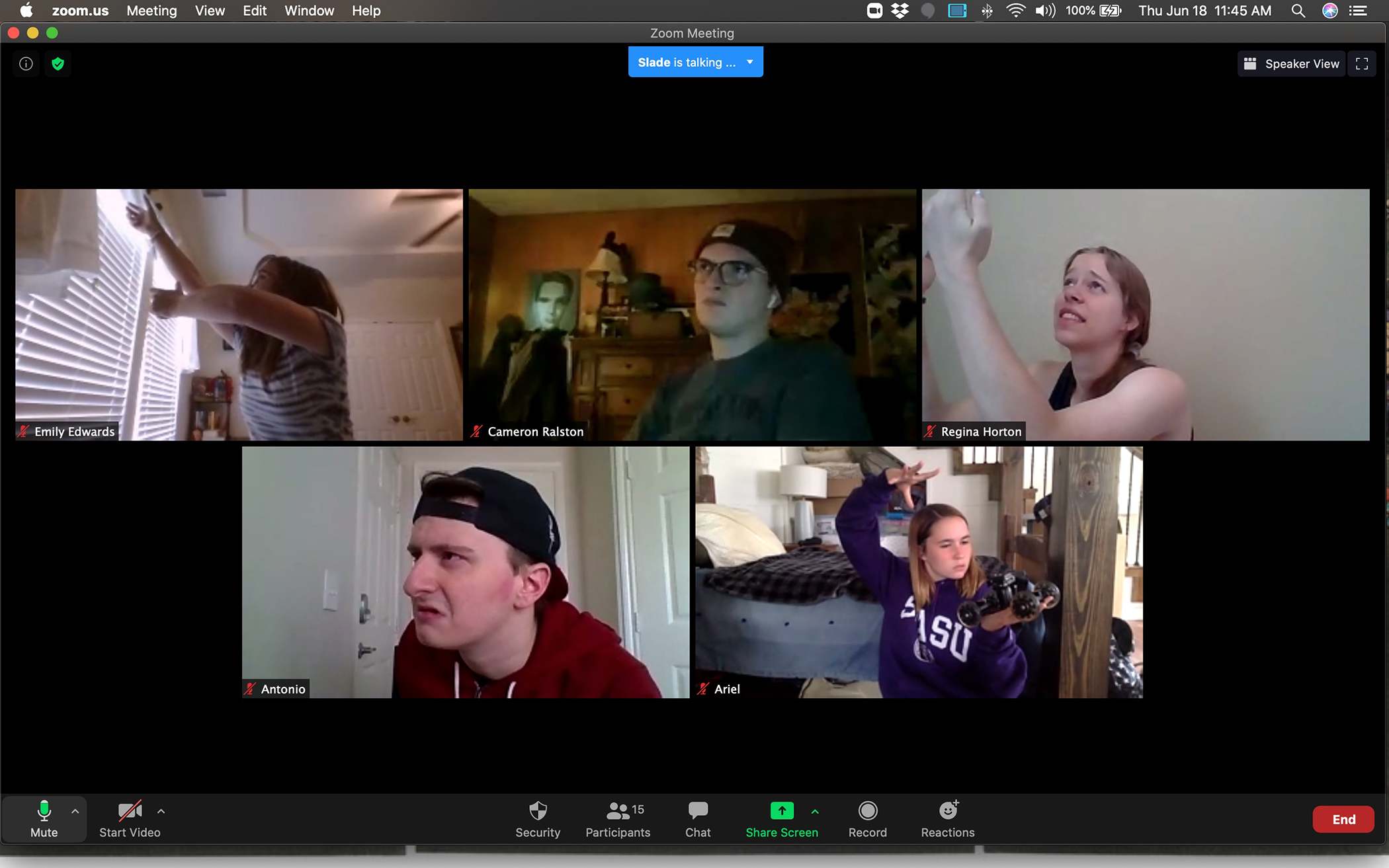
SFA theatre students rehearse on Zoom for the upcoming virtual presentation of Shakespeare's "The Tempest." The show can be accessed live online for three consecutive nights starting June 30 and in a recorded version the following three days, July 3 through 5. Online access can be purchased through the College of Fine Arts Box Office.

SFA theatre students rehearse on Zoom for the upcoming virtual presentation of Shakespeare’s “The Tempest.” The show can be accessed live online for three consecutive nights starting June 30 and in a recorded version the following three days, July 3 through 5. Online access can be purchased through the College of Fine Arts Box Office.

“The Tempest” rehearsals started a few weeks ago with Stephen F. Austin State University theatre students doing all the traditional elements of theatrical rehearsal, like script analysis and blocking, while also discovering the opportunities and limitations of creating and presenting a play totally online as a result of the COVID-19 pandemic.

William Shakespeare’s “The Tempest” will be presented live online for three consecutive nights starting June 30 and in a recorded version the following three days, July 3 through 5. Online access can be purchased through the College of Fine Arts Box Office.

Selected for the School of Theatre’s SummerStage Festival, “The Tempest” is a story of isolation and loss, but it is also about the power of life to continue and of humanity to recover, according to Slade Billew, assistant professor of theatre and director of the play. The script blends tragedy, comedy, songs and magic.

The play will be “created” entirely over the internet, with rehearsals conducted via Zoom, and designers conceiving and creating work in their own personal spaces. The same theatrical instruction that was taking place in the classroom six month ago is now being delivered virtually.

“There will be all of the elements of a traditional production, just in a different medium,” said Billew. “We have students and faculty working with all of the areas of design. We are figuring things out within our limitations. For example, we can’t mail students theatrical lighting instruments, but we are coming up with ways to create unique lighting and sound effects in the spaces of the performers’ homes.”

Students will use a range of other tools, including some puppetry and a mix of built and found objects and costumes.

“We are looking for ways that students can be mailed costume or prop pieces,” Billew said, “or be sent files to print and assemble themselves. We want this to be as fully realized a production as possible.”

Billew anticipates encountering a range of technological glitches. “We also lose the creative energy of all being in a room together – something I know the country as a whole is struggling with right now,” he said. “Also, we are adapting to a whole new form of performance where the modes of creation and communication are different.”

In normal SFA production circumstances, theatre students work with a high level of theatrical design and technological support. While this is great for their education, it’s not what many of them will encounter in their early professional careers, Billew said, adding this new process will help them learn to create the best work they can with limited resources.

“Many early career theatre and film artists are now getting their start on YouTube and other platforms where they generate their own work,” he said. “This project will give our students a leg up in learning how to do that.”

Despite the need for actors to perform in front of live audiences, School of Theatre Director Cleo House Jr. predicts that theatre will be forever changed because of the pandemic, and SFA’s response to what’s happening “really is what theatre has always been about,” he said.

“Theatre remains in a consistent state change … of action and reaction … meaning the world happens around us, and theatre responds,” House said. “It reacts by holding up a mirror. Theatre has to be this way because it is a living yet ephemeral entity. Living things change; they adapt, they move, or they die. Our actions in moving forward with the support of the College of Fine Arts speaks to SFA’s continued value for the impact of what we do in theatre, and our audience support is appreciated and needed.”

Once donations/purchases are made for live performance, the School of Theatre will contact the purchaser by email three hours before the live performances to provide a link for access. Live performances are at 7:30 p.m. June 30, July 1 and July 2. The recorded performance will be available July 3 though 5. Passcodes for July 3 through 5 will be ongoing and released daily at noon. The link dies at midnight each night with a new link for each day. Access for each day should be purchased separately. Access levels range from $5 to $25.

To purchase online access, visit boxoffice.sfasu.edu or call (936) 468-6407 for online purchasing questions. For more information about the School of Theatre, visit theatre.sfasu.edu.

Posted in All SFA, SFA News | Leave a comment

June 18, 2020: NPD Crime Report

This is a complete list of reports responded to by the Nacogdoches Police Department

This page may take a moment to load.

Click Here to load a separate PDF file

Posted in All Police, NPD Crime Log | Leave a comment

June 18, 2020: Nacogdoches Sheriff’s Crime Log

This is the report from the Nacogdoches County Jail that lists the arrests made from 6 a.m. of the previous day to 6 a.m. of the listed day.

This page may take a moment to load

Click Here to load a separate PDF file

Posted in All Police, SO Crime Log | Leave a comment

June 18, 2020: Nacogdoches County Booking Report

This is the report from the Nacogdoches County Jail that lists the arrests made from 6 a.m. of the previous day to 6 a.m. of the listed day.

This page may take a moment to load

If you are having trouble loading the mugshots please try using a different internet browser

Click Here to load a separate PDF file

Posted in All Police, Booking | Leave a comment

MAJOR ACCIDENT AT THE INTERSECTION OF N. UNIVERSITY DR AND E. AUSTIN ST

(June 17, 2020): The Nacogdoches Police Department and Fire Department responded to a three vehicle major accident Tuesday evening around 6:07 p.m. at the intersection of N. University Dr. and E. Austin Street. The investigation revealed that a GMC Canyon pickup driven by Zachary Cleveland of Nacogdoches was northbound on N. University and collided with a westbound Volkswagen car driven by Margaret Naranjo, also of Nacogdoches. The collision sent both vehicles northbound, colliding with a Ford Ranger pickup, driven by Lucresha Phillips, also of Nacogdoches. Cleveland and Phillips were uninjured in the accident, however Naranjo suffered serious injuries and was transported to Nacogdoches Memorial Hospital, and then later flown to a Tyler hospital. The NPD Traffic Unit is continuing to investigate the accident to determine factors and causes of the collision.

The roadway was closed from approximately 6:07 p.m. Tuesday until 2:00 a.m. Wednesday. As further information becomes available it will be released.

Posted in All Police, Police News | Leave a comment

SFA researchers study iconic, threatened turtle species of the Southeast

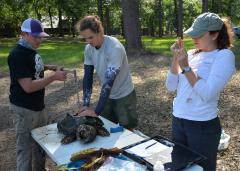
Thanks to funding from the U.S. Fish and Wildlife Service’s State Wildlife Grant Program, researchers at Stephen F. Austin State University’s Arthur Temple College of Forestry and Agriculture are investigating the occupancy and mercury content of alligator snapping turtles throughout East Texas. The species, once widely distributed throughout the Southeastern U.S., is now listed as a species of conservation concern by every state within its natural range. Pictured from left, SFA researchers John Michael Arnett, David Rosenbaum and Laura St. Andrews take measurements of the upper part of the shell, known as the carapace, of an alligator snapping turtle.

Thanks to funding from the U.S. Fish and Wildlife Service’s State Wildlife Grant Program, researchers at Stephen F. Austin State University’s Arthur Temple College of Forestry and Agriculture are investigating the occupancy and mercury content of alligator snapping turtles throughout East Texas. The species, once widely distributed throughout the Southeastern U.S., is now listed as a species of conservation concern by every state within its natural range. Pictured from left, SFA researchers John Michael Arnett, David Rosenbaum and Laura St. Andrews take measurements of the upper part of the shell, known as the carapace, of an alligator snapping turtle.

During one of the last cool mornings in May, an aluminum boat filled with four Stephen F. Austin State University researchers navigated a muddy waterway to a hoop net trap located under the drooping limbs of a streamside tree. As forestry graduate student David Rosenbaum balanced on the bow of the boat and hoisted the trap above the water, Dr. Christopher Schalk, assistant professor of forest wildlife management, released a shout of excitement as the wide, spiked, moss-covered shell of an alligator snapping turtle became visible.

While the untrained eye can easily confuse this species with the common snapping turtle, there are distinct characteristics that set the two apart.

“The most obvious difference is size,” Schalk said. “Alligator snapping turtles achieve a much larger size than the common snapping turtle.”

Schalk said the record weight for a wild-caught alligator snapping turtle is 126 pounds, while the weight of a common snapping turtle ranges from 10 to 35 pounds.

Another defining characteristic of the alligator snapping turtle is the appearance of the hard, upper part of the shell known as the carapace.

“The alligator snapping turtle has much stronger serrations on the shell and along its edge compared to common snapping turtles,” Schalk said. “However, those can actually wear down over time due to older turtles rubbing up against root banks.”

Given its sheer size and prehistoric appearance, it’s not hyperbolic to refer to this species as dinosaurs of the turtle world. Evidence suggests ancestors of the alligator snapping turtle began to appear in the fossil record more than five million years ago during the Miocene era. Since then, descendants of that ancient species carved a niche in the waterways of the Southeastern U.S.
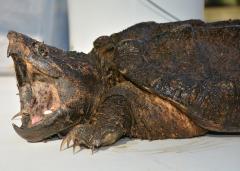
 While often confused with the common snapping turtle, distinct characteristics, such as its large size, pronounced beak and defined serrations along the alligator snapping turtle’s shell, set the two species apart. It is illegal to harvest alligator snapping turtles in Texas, and the U.S. Fish and Wildlife Service is currently considering federal protection of the species under the Endangered Species Act.

While often confused with the common snapping turtle, distinct characteristics, such as its large size, pronounced beak and defined serrations along the alligator snapping turtle’s shell, set the two species apart. It is illegal to harvest alligator snapping turtles in Texas, and the U.S. Fish and Wildlife Service is currently considering federal protection of the species under the Endangered Species Act.

However, modern populations of the alligator snapping turtle, the largest freshwater turtle species in North America, have been so drastically reduced that it is now listed as a species of conservation concern by every state within its natural range. The U.S. Fish and Wildlife Service also is considering federal protection of the species under the Endangered Species Act.

Rosenbaum explained that life history traits of the species, along with unregulated harvest and habitat loss, have resulted in a cascading destructive effect that recently led Texas to change the species’ status from threatened to imperiled.

“They take a long time to reach sexual maturity, and their nests have a really high mortality rate,” Rosenbaum said. “If you kill one adult female in a population it has a huge effect down the line because that female could have produced offspring year after year for 50 years.”

Rosenbaum’s research, funded by the U.S. Fish and Wildlife Service’s State Wildlife Grant Program and allocated by the Texas Parks and Wildlife Department, builds upon previous work conducted by the Texas Parks and Wildlife Department to determine the species’ distribution and occupancy throughout East Texas.

During the next two summers, Rosenbaum will survey 23 sites across 20 counties spanning from the Sabine River north to the Red River and southwest to the Navasota River.

“My main goal next summer is to fill in the gaps where records of the alligator snapping turtle are missing,” Rosenbaum said. “There are a few counties that have no records of the species, but the counties surrounding them have documentation and suitable habitat.”

In addition to documenting and marking the turtles, Rosenbaum is collecting tissue to analyze the bioaccumulation of mercury.

“You tend to see mercury biomagnify as you move up the food chain, so with each trophic transfer, you’re becoming heavier in mercury,” Schalk said. “Alligator snapping turtles are major predators, and a lot of the fish they eat are already high up on the food chain to begin with, so they’re going to potentially be heavier in mercury.”

Once prized for its meat, it is illegal to harvest an alligator snapping turtle in Texas, and personal harvest is limited in Louisiana. Despite this, both Schalk and Rosenbaum said illegal poaching still occurs.

“In some cases, people are still consuming them,” Schalk said. “Aside from their threatened status, alligator snapping turtles possess traits that, in my opinion, make them an undesirable source of meat because of the way mercury bioaccumulation occurs.”

Because the species is almost exclusively aquatic, with females emerging only to nest on land, they can be overshadowed by more visible, terrestrial threatened or endangered species, such as the Texas horned lizard or red-cockaded woodpecker. Their lack of visibility, however, does not imply a lack of ecological importance.

“It’s an iconic species here in Texas,” Schalk said. “They’re a good indicator species for a healthy ecosystem — one that’s not overfished and has stable populations that are indicative of low anthropogenic impacts.”

In addition to being a top predator, Schalk also explained that the turtles actually produce a considerable amount of food for other animals, such as raccoons, opossums and larger fish through the predation of nests and juveniles.

“They’re a pretty easy animal to be enthusiastic about just because they’re so large and aggressive looking,” Rosenbaum said. “There’s definitely an air of mystery and lore about them that makes them attention grabbing.”

For more information on this and other research, visit atcofa.sfasu.edu.

Story by Sarah Fuller, outreach coordinator for Stephen F. Austin State University’s Arthur Temple College of Forestry and Agriculture. Contact information: (936) 468-1185 or fullersa@sfasu.edu.

Posted in All SFA, SFA News | Leave a comment

June 17, 2020: NPD Crime Report

This is a complete list of reports responded to by the Nacogdoches Police Department

This page may take a moment to load.

Click Here to load a separate PDF file

Posted in All Police, NPD Crime Log | Leave a comment