

Allergen-aware station, increased safety measures part of SFA’s student center dining hall renovation
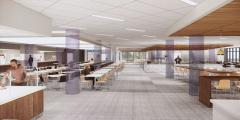
A digital rendering of Stephen F. Austin State University’s Baker Pattillo Student Center dining hall renovation project provides a glimpse of the facility’s modernized look. The project is scheduled to be complete before the start of the fall semester and includes plans for social distancing and increased student safety.
Other major features include a dedicated “plant-forward” produce station to replace the former salad bar, a redesigned bakery allowing for confectionary pickup orders, a meat carvery station that will focus on lean meats, and the implementation of various physical distancing and health safety measures.
Construction began in April and is scheduled to be complete before the start of the fall semester.
“Because there are millions of people with food allergies, we knew we needed to better serve our students by having a more inclusive concept in the dining hall,” explained Carrie Charley, SFA’s director of auxiliary services. “In a commercial kitchen, it is nearly impossible to prevent cross-contamination. At this new allergen-aware station, all ingredients are kept separate from other dining hall menu items from the moment they arrive on the student center’s back dock until the moment the dish is served.”
The innovative meals offered through the station will be free of seven of the eight most common food allergens: milk, egg, peanut, tree nut, soy, wheat and shellfish. The eighth allergen, finfish, was kept to provide sufficient protein variety, Charley said.
“For the past several years, we’ve been tracking how many students have dietary restrictions, and that number has increased,” said Jill Hamilton, an Aramark senior specialist registered dietitian. “The allergen awareness station was added to make it easier for those with restrictions to identify offerings. Even if someone doesn’t have an allergy, I think they will still enjoy the station.”
While some dietary restrictions are based on a diner’s personal preferences, food allergies are not, and exposure to certain food products can be potentially dangerous to students with those allergies. Allergen-aware staff members will prepare dishes using dedicated kitchenware and utensils that have been thoroughly washed and sanitized between uses.
SFA has, for years, utilized allergen and nutritional information cards, which are placed near each dish at dining hall stations. The new dedicated station is the next step toward ensuring increased levels of student health awareness and dietary flexibility.
While universities nationwide are expanding their allergen-aware accommodations, SFA “might be one of the first to also use this new space as a teaching kitchen,” Charley said. “Once we are able to safely do so, we hope to host teaching tutorials and cooking competitions from this space in the evenings and during special events. We have special seating designed around the area that is movable and customizable for small groups.”
The concept of plant-forward offerings, which emphasizes “healthy plants at the center of the plate with a proportionally small quantity of animal protein,” Hamilton explained, is not a new one. SFA began adding plant-forward dishes two years ago, including such offerings as lentil “meat” loaf, grilled veggie skewers and cauliflower wings.
Several other stations in the dining hall also offer plant-forward dishes, but the newly revamped and expanded plant-forward produce station will provide a dedicated space for and expansion of these offerings. It also provides more flexible and diverse options for vegan and vegetarian diets, although every station also includes a vegan dish.
“I am super excited about the new produce station,” Charley said. “According to Dataessential, nearly 40% of Americans say they are eating less red meat and are seeking more vegetables. This trend is called ‘plant forward,’ putting plants (fruits, veggies, whole grains, nuts, beans) at the center of your plate. This renovation bursts open the doors to new possibilities for dining on our campus with a fresh perspective, fresh ingredients and a bright new landscape to enjoy meals together.”
Aside from expanding food options, the student center dining hall renovation also has updated food service procedures and modernized seating and dining aesthetics.
“The entrance to the dining hall has been expanded by 16 feet and provides a more open view into the entire facility,” Charley said. “There are three self-check-in stations and also pre-packaged to-go meals available.”
With the outbreak of COVID-19, additional safety and distancing measures were added to the renovation project, including the design of 25%, 50% and 75% capacity seating plans by architects Tipton Associates, based in Baton Rouge, Louisiana.
“With those plans, we will be able to adjust as needed before it is time to load the furniture in,” Charley said. “Most of the crowd control and occupancy management will be handled by the dining team, with the cooperation of our guests. The new check-in stations are self-swipe, and the dining team will serve food rather than having self-service, keeping things as contactless as possible. We now also have outdoor seating available facing the beautiful view down Vista Drive.”
Visual cues will be implemented throughout the hall to keep diners at a safe distance from each other. Sneeze guards have been a standard fixture in all dining halls, but extra guards were added to fill gaps.
“Face masks are required to be worn while in line and walking from station to station,” Charley added. “You also will see staff members in masks and frequently cleaning throughout the day. You might see that a station is temporarily closed during 15-minute intervals for deep cleaning and utensil replacement.”
For more information on fall 2020 dining options and updates, visit the “Dining” section on sfasu.edu/fall2020.
By Christine Broussard, marketing communications coordinator at Stephen F. Austin State University.
Posted in All SFA, SFA News
Leave a comment
July 22, 2020: NPD Crime Report

This is a complete list of reports responded to by the Nacogdoches Police Department
This page may take a moment to load.
Posted in All Police, NPD Crime Log
Leave a comment
July 22, 2020: Nacogdoches Sheriff’s Crime Log

This is the report from the Nacogdoches County Jail that lists the arrests made from 6 a.m. of the previous day to 6 a.m. of the listed day.

This page may take a moment to load
Posted in All Police, SO Crime Log
Leave a comment
July 22, 2020: Nacogdoches County Booking Report
This is the report from the Nacogdoches County Jail that lists the arrests made from 6 a.m. of the previous day to 6 a.m. of the listed day.

This page may take a moment to load
If you are having trouble loading the mugshots please try using a different internet browser
Posted in All Police, Booking
Leave a comment
SFA regents approve faculty and staff appointments
The appointments of three Stephen F. Austin State University faculty members to serve in interim leadership roles were approved by the Board of Regents during a regularly scheduled meeting today.
Matthew Beauregard, professor of mathematics and statistics, was named interim chair of the Department of Physics, Engineering and Astronomy. Beauregard holds a degree from the University of New Hampshire and a master’s degree and doctorate from the University of Arizona at Tucson. He joined the SFA faculty in 2014.
Kevin Langford, associate professor of biology and director of pre-health professions programs, is serving as interim chair of the Department of Biology. Langford joined the SFA faculty in 2002 and holds degrees from SFA and a doctoral degree from the Medical College of Wisconsin.
Chay Runnels, associate professor of human sciences, was approved to serve as interim director of the School of Human Sciences. Runnels holds degrees from the University of Texas and a doctoral degree from SFA and joined the SFA faculty in 2005. She replaces Dr. Lynda Martin, whose retirement was approved by regents.
Also in the education college, Ginney Love Watkins, a master teacher in the Early Childhood Lab, was approved as a visiting assistant professor of human sciences. Kelly Finnerud, who previously served as a teacher aide and substitute teacher, was appointed to a teaching position at the Charter School. Ande Wallace also was approved as a Charter School teacher.
Elizabeth Gound’s promotion to assistant professor of elementary education was approved by regents, and Tonya Jeffery and Kevin Jones were approved as new assistant professors of education studies. Other approvals included Jill Pruett, clinical instructor of human sciences; Elaine Turner, assistant professor of human services and educational leadership; and Robyn Whitehead, assistant professor of kinesiology.
Appointments in the College of Sciences and Mathematics included Jeremy Becnel, a professor of mathematics and statistics, who was approved to serve as a professor of computer science. The appointment of Dipak Singh as an assistant professor of computer science also was approved.
Jordan Baker, Morgan Benton, Sherry Cheever and Ashley Goar were approved as clinical instructors of nursing
New faculty members in the College of Fine Arts included Margaret Fay, visiting assistant professor of music, and James Taylor, lecturer of sound recording technology.
In the College of Liberal and Applied Arts, Christine Bishop and Ronald Rush were approved as assistant professors of social work. Gregory Smith is a lecturer for languages, cultures and communication, and Spencer Willardson is an assistant professor of government.
In Human Resources, John Wyatt was promoted from assistant director to associate director. The promotions of Lisa Balty and Deja Peterson from human resources representatives to senior human resources representatives were approved, as was the promotion of Kimberly Odems, from specialist III to senior human resources representative.
Tanner Boyd and Colleen Gallagher were approved to serve as assistant general counsels to the university. Deborah Rossler was approved as construction project manager in the Physical Plant.
The appointment of Marcus Walker as assistant football coach was approved by regents, as was the promotion of Aidan Pool, from athletic training graduate assistant to athletic trainer.
Faculty development leave was approved for Jane Long, mathematics and statistics, for the spring 2022 semester.
Regents approved the retirement of Gary Kronrad and his appointment as Professor Emeritus of forestry and environmental science. Other retirements approved included Neill Armstrong, secondary education; Larry Bishop, English and creative writing; Regina Brown and Cynthia McCarley, nursing; Deborah Cady and Robbie Steward, human services; Jere Jackson, Center for East Texas Studies; Marcus Madden, University Police Department; and Karren Price, government.
Posted in All SFA, SFA News
Leave a comment
SFA Board of Regents approves university budget for upcoming year
SFA Board of Regents approves university budget for upcoming year
While COVID-19 and Stephen F. Austin State University’s response to the pandemic were top concerns during the July quarterly meeting of the Board of Regents, actions taken were geared toward the future of the university.
Regents heard reports regarding the university’s plans to open campus for the fall semester and approved the budget for the upcoming academic year.
“This is the most complicated budget process we’ve ever been through,” said Dr. Danny Gallant, vice president for finance and administration. “We started with a flat budget and then reduced revenue projections an additional 5%. Based on instructions state agencies received from the governor’s office, the university reduced an additional $1.6 million to provide a biennial reduction of $3.65 million.”
The university received CARES Act funding of approximately $11 million, with $5.3 million allocated to student financial relief.
“We have disbursed to students who were eligible during the spring, and remaining funds will be available to students this fall,” Gallant said.
While some of the CARES Act funding was used to cover the costs of refunds distributed to students for housing, meal plans, parking and other fees, $2.6 million was allocated to classroom upgrades to facilitate distance learning, according to Dr. Steve Bullard, provost and vice president for academic affairs.
“Nearly 90 classrooms have been upgraded to support Zoom capabilities,” Bullard said. “They will function as lecture-style classrooms for students attending in person, and students joining the class via Zoom will see and hear the professor and be able to interact with the class.”
According to Bullard, as of July 17, 51% of SFA classes were slated to be face to face, 17% were online and 28% were hybrid, so that students can access the course in either manner.
“Options for students will continue to advance in coming weeks, as we move more of our course sections to distance-related options,” he said.
Budget reductions also necessitated freezes on hiring and university travel, as well as furloughs for staff members. The university also introduced a voluntary separation incentive plan being offered to employees who are eligible to retire, which was approved by regents.
“This is a way to reduce our payroll and eventually realize savings,” Gallant said. “It’s a great opportunity for those employees who have reached retirement eligibility, and also will be beneficial to the university.”
Gallant said according to university records, 220 current employees are eligible to participate in the program, and 57 employees have applied.
“The deadline is July 31, so we are likely to receive additional applications,” he said.
Regents heard an update regarding the renovation and addition to the Griffith Fine Arts Building and approved funding for a power-plant upgrade and associated utility infrastructure improvements at a cost not to exceed $2 million. They also approved roof replacement at the Norton Health and Physical Education Building.
Facility improvements being made at Johnson Coliseum have eliminated the need for a strength and conditioning room in a basement area of the building, which was approved by regents in 2018. Regents voted to return funding for the project, now totaling approximately $724,387, to the university’s designated fund balance.
Regents authorized SFA administrators to submit a legislative appropriations request to the Texas Legislature for capital funding to support the development of an interdisciplinary and applied sciences building, an agriculture and technology complex, and a special item request for programming funds to establish a center for applied research and rural innovation.
“These would be transformative for our campus and our region,” said Dr. Scott Gordon, SFA president. “However, we understand the current economic conditions of Texas and see funding for these projects as a long shot during this legislative session. We know from prior experience that even in these difficult times, we should present our requests and priorities, so we have compiled this proposal to indicate that we are looking to the future needs of the state and how SFA can help to meet those needs.”
The agriculture and technology complex would be located at SFA’s Todd Agricultural Research Center, a 490-acre complex located on U.S. Highway 259.
“In addition to agricultural engineering and industrial engineering technology programs, the facility would allow for the expansion of programs in areas that could include advanced manufacturing and industrial supervision, as well as programs such as veterinary technology and veterinary nursing,” Gordon said. “The facility for interdisciplinary and applied sciences would be connected to our Forestry Building and would build on the synergies between programs. It will include offices and classrooms for subjects including agriculture, biology, environmental and geospatial sciences, and geology.”
Regents approved the renewal of a five-year contract with EAB Global for the Navigate program, which includes a student success management platform and best-practice research. Regents also approved the use of quasi-endowment funds by the College of Liberal and Applied Arts to support the redesign of core curriculum courses.
“Merely adopting the latest textbooks does not mean the overall structure of an academic program is providing the integrated knowledge base a student should possess upon graduation,” said Dr. Brian Murphy, dean of the College of Liberal and Applied Arts. “Most students in a core course are not majors in the instructor’s discipline, and the aim of our redesign is to make a core course meaningful, interesting, and relevant at the current time and five years after the student graduates.”
Murphy said educators must adapt in order to teach the skill sets that are relevant in the marketplace.
“Our faculty members are adopting the pedagogical approaches that have been identified as facilitating this transition, such as experiential learning and gamification,” he said.
Regents also approved funding for the purchase and replacement of computers and cloud software, as well as grant awards, changes in course fees and the online-only fee, and policy revisions.
Regents heard reports from SFA President Gordon; Dr. Andrew Lannen, chair of the Faculty Senate; and Christopher Moore, Student Government Association president. Members elected the individuals who serve in positions that report to the board and approved:
· minutes from previous meetings
· holiday schedule for 2020-21
· annual audit plan and audit services report
· and curriculum changes and low-producing programs.
To view recorded meetings of the SFA Board of Regents, visit sfasu.edu/regents.
Posted in All SFA, SFA News
Leave a comment
July 21, 2020: NPD Crime Report
This is a complete list of reports responded to by the Nacogdoches Police Department
This page may take a moment to load.
Posted in All Police, NPD Crime Log
Leave a comment
July 21, 2020: Nacogdoches Sheriff’s Crime Log
This is the report from the Nacogdoches County Jail that lists the arrests made from 6 a.m. of the previous day to 6 a.m. of the listed day.
This page may take a moment to load
Posted in All Police, SO Crime Log
Leave a comment
July 21, 2020: Nacogdoches County Booking Report
This is the report from the Nacogdoches County Jail that lists the arrests made from 6 a.m. of the previous day to 6 a.m. of the listed day.
This page may take a moment to load
If you are having trouble loading the mugshots please try using a different internet browser
Posted in All Police, Booking
Leave a comment