
This is the report from the Nacogdoches County Jail that lists the arrests made from 6 a.m. of the previous day to 6 a.m. of the listed day.

This page may take a moment to load
This is the report from the Nacogdoches County Jail that lists the arrests made from 6 a.m. of the previous day to 6 a.m. of the listed day.
This page may take a moment to load
This is the report from the Nacogdoches County Jail that lists the arrests made from 6 a.m. of the previous day to 6 a.m. of the listed day.

This page may take a moment to load
If you are having trouble loading the mugshots please try using a different internet browser

Dr. Steve Cooper, Stephen F. Austin State University School of Social Work associate director of research, leads a discussion with Nacogdoches County community members about the recent grant received from the Hogg Foundation for Mental Health. The $410,000 grant funds an initiative focusing on identifying and improving the mental health conditions of the local community.
The grant funds an initiative focusing on identifying and improving the mental health conditions of Nacogdoches County. More than 60 rural counties from around Texas applied for the grant. Other counties receiving the grant are Bastrop, Brooks, Morris and Victoria.
Dr. Steve Cooper, associate director of research for SFA’s School of Social Work, said this grant will help determine the steps that need to be taken to improve the county’s overall mental health.
“The Hogg Foundation looks at rural areas’ need for better mental health,” Cooper said. “This particular initiative allows the community to say what the issue is. This grant funds the facilitation of a community-driven process of identifying the needs related to mental health and deciding how to go about addressing them.”
For the purposes of this initiative, the Hogg Foundation defines well-being as the holistic state of being well and feeling content in life. The concept includes feeling grounded emotionally, mentally, socially and spiritually. Mental health is an essential component of well-being.
“This isn’t just more money to do more of the same things,” Rick Ybarra, program officer for the Hogg Foundation, said. “The hope is that these grantees will pioneer new approaches to resilience, mental health and well-being that we can all learn from.”
According to research conducted by the Hogg Foundation in 2015, 185 Texas counties lacked having a psychiatrist, while 149 of these counties were without a licensed psychologist and 40 lacked having a social worker. The Hogg Foundation’s initiative aims to shift the focus from individual mental illnesses to the conditions that support mental health at the community and systems level.
Cooper said that there has been a push toward recovery within mental health care in the past decade, but rural communities often lack the funds and/or resources to achieve better mental health care.
“People are often looked at as sick forever if they have chronic mental illness, but with help they can become more independent,” Cooper said. “The idea behind this movement is that anyone can get better with support. This means that each member of the community can positively affect an individual’s mental health.”
The Center for Rural Social Work Research and Development within SFA’s School of Social Work is housing the grant. Cooper will be spearheading the work along with Dr. Emmerentie Oliphant, director of the Master of Social Work program at SFA.
Additionally, students within the School of Social Work will have the opportunity to assist with the process and gain real-world experience. Both undergraduate and graduate students will help gather data on the community’s mental well-being, participate in community meetings and more.
The grant will last three years, and the initiative is divided into two stages. The first 12 to 18 months will focus on engaging with the community in an appreciative inquiry model to determine the specific mental health needs. In this stage, various community members and organizations will gather information and begin work to enhance the county’s mental health care.
“This is not just something SFA is doing; instead, it is a community-driven initiative,” Cooper said.
SFA and 15 community partners will periodically meet throughout the initiative. Cooper said that the group comprises a very inclusive community. “This is the first time Nacogdoches County is focusing on community mental health,” Cooper said, “and we anticipate that as word grows, more and more organizations and individuals will want to participate in this initiative.”
The second stage of the grant will involve implementing resources and information within the community on the needs of the county. The results of the first stage will help determine the next steps to be taken. These steps will lead the community toward becoming more conducive to wellness and well-being.
“Our goal with this grant will focus on becoming a trauma-informed community,” Cooper said. “Regardless of an individual’s own mental health, we want every community member to have access to information and resources regarding their well-being. Everyone deserves help with their mental health.”
To learn more about this initiative, contact Dr. Steve Cooper at scooper@sfasu.edu or (936) 468-2845.
By Emily Brown, marketing communications specialist for Stephen F. Austin State University.

A documentary about the life of renowned German art forger Wolfgang Beltracchi will be screened at 7 p.m. Friday, Aug. 3, in The Cole Art Center @ The Old Opera House in downtown Nacogdoches.
The documentary is described at imdb.com as “a mesmerizing, thought-provoking yet surprisingly amusing documentary on the life and times of Wolfgang Beltracchi, who tricked the international art world for nearly 40 years by forging and selling paintings of early 20th-century masters.”
“Beltracchi: The Art of Forgery” earned Best Documentary at the 2014 German Film Awards and winner in Documentary in Fine Art and Photography at the 2016 Master of Art Film Festival. The film is directed by Arne Birkenstock.
The screening is part of the School of Art’s monthly Friday Film Series and is sponsored in part by William Arscott, Nacogdoches Film Festival, Karon Gillespie, Mike Mollot, David Kulhavy, Brad Maule, John and Kristen Heath, Galleria Z, Jill Carrington, Jean Stephens, Jim and Mary Neal, Richard Orton, Nacogdoches Junior Forum and Main Street Nacogdoches.
The Cole Art Center is located at 329 E. Main St. For more information, call (936) 468-1131.
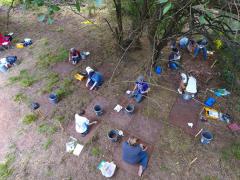
Stephen F. Austin State University anthropology students spent five weeks excavating Millard’s barn as part of SFA’s field methods in archaeology course. The course provides students with the opportunity to participate in tangible excavations and research. Photo credit: Linda Bratcher and Katherine Coleman.
Students who participated in SFA’s field school with Dr. Leslie Cecil, chair and professor of the Department of Anthropology, Geography and Sociology, spent five weeks excavating the historic Millard barn. This is the first time the farmstead was excavated.
The research project’s primary goal was to document the existence of the barn while attempting to discover as much as possible about the area. The information obtained will be used to further record Nacogdoches’ history from the 1830s to1860s.
“The focus of this research was to learn more about the Millard family and how they lived during the mid-1800s,” Megan Zewe, SFA anthropology student, said. “The excavation is important because it allows us to learn about the city’s past in a way that is more real and in-depth than a textbook.”
Archaeology field school is a required course for students with an anthropology emphasis and interest in archaeology. This summer’s field school students participated in all stages of the excavation and conducted their own lab work. Each student was responsible for excavating one small plot while working alongside Cecil and other anthropology professors.
According to Cecil, a secondary goal of the course is to provide students with the necessary experience for graduate school and employment in the field.
“The purpose of field school is to give students interested in archaeology hands-on experience in the field to see if this is really what they want to do,” Cecil said. “Since so much of an archaeologist’s work is outdoors, it makes sense to spend some time in the heat among the bugs and dirt. Although lab work is essential to the profession, it’s the work in the field that is fundamental.”
Cecil said future field school classes will continue the work and research conducted this summer. Excavations through 2020 will expand to include the main house and perimeter of the crib barn.
By Emily Brown, marketing communications specialist at Stephen F. Austin State University.

This is a complete list of reports responded to by the Nacogdoches Police Department
This page may take a moment to load.
This is the report from the Nacogdoches County Jail that lists the arrests made from 6 a.m. of the previous day to 6 a.m. of the listed day.
This page may take a moment to load
This is the report from the Nacogdoches County Jail that lists the arrests made from 6 a.m. of the previous day to 6 a.m. of the listed day.
This page may take a moment to load
If you are having trouble loading the mugshots please try using a different internet browser
Stephen F. Austin State University’s Board of Regents approved several leadership changes during its Tuesday meeting.
Dr. Marc Guidry was approved as associate provost for academic affairs. As a member of the SFA faculty since 1999, Guidry is familiar to many on campus. In addition to his teaching responsibilities in the Department of English and Creative Writing, Guidry has served as associate dean of the College of Liberal and Applied Arts since 2012.
He has been a member of several campuswide committees and in 2016 received a Distinguished Grant Award from the SFA Office of Research and Sponsored Programs. Guidry holds a Bachelor of Arts in English from Loyola University, and master’s and doctoral degrees in English from Louisiana State University.
Erma Nieto Brecht was appointed executive director of enrollment management. Since 2004, Brecht has served as director of admissions at Texas Woman’s University and was responsible for developing, implementing, and managing all aspects of recruiting and admissions counseling. She has 25 years of experience with documented success in increasing retention rates and enrollment.
Brecht holds bachelor’s and master’s degrees from the University of Houston and is scheduled to complete a doctoral degree in higher education administration in December.
Additionally, regents appointed Ryan Ivey as the director of intercollegiate athletics. Ivey comes to SFA after serving as athletic director at Austin Peay State University in Clarksville, Tennessee, where he was responsible for 15 sports and a $12.5 million athletics budget.
Ivey earned a bachelor’s degree in sports management and a master’s degree in sports commerce from the University of Memphis, where he was a punter for the football team.
From the College of Liberal and Applied Arts, Dr. Joyce Johnston was appointed associate dean of the college. Formerly interim director for the Division of Multidisciplinary Programs and French professor, Johnston has been a member of the SFA faculty since 2007. She has held many roles, including director of the Pre-Law Academy for high school students, coordinator of SFA’s gender studies program and director of multidisciplinary programs. Johnston has taught all levels of French literature, language and culture; instructed graduate-level Hispanic studies; implemented study abroad trips; and served on university, college and departmental committees.
Dr. Troy Davis was named professor and chair of the Department of History. A member of the faculty since 1999, Davis has taught courses including the history of Western civilization, American history and history of Ireland. He received his bachelor’s degree from Texas Christian University and his master’s and doctoral degrees in modern European history from Marquette University in Milwaukee, Wisconsin.
Dr. William Bruton, associate dean and professor of physics, engineering and astronomy, was named professor and director of engineering. Bruton teaches a variety of courses and conducts research at the SFA Observatory. With assistance from many students, Bruton has discovered 11 asteroids. He received his bachelor’s and master’s degrees from SFA and doctoral degree from Texas A&M University.
Dr. Tamara Harris was approved as associate professor and director of nursing for the DeWitt School of Nursing. For many years, Harris has worked in the medical industry in various capacities. As a nurse practitioner, she gained experience with post-operative care, patient education, and prenatal and postpartum care.
Dr. Deborah Dunn was named professor and chair of the Department of Computer Science. Dunn worked for more than five years in the industry as a programmer/analyst for a major oil company. Prior to joining the SFA faculty, she taught at various universities and colleges while also serving in leadership roles.
Regents approved Dr. Ray Darville as professor and chair of the Department of Anthropology, Geography and Sociology. Darville has served SFA for 30 years in various roles in areas such as sociology, communication, and forestry and agriculture. He was honored as Regents Professor for 2015-16. Darville received his bachelor’s degree from East Texas Baptist University, master’s degree from SFA and doctoral degree from the University of North Texas.
Dr. Dana Cooper was approved as professor of history and SFA 101 coordinator. Cooper has been at SFA since 2007, is a former Faculty Senate chair, and was named a Distinguished Professor in 2016. The SFA 101 program helps first-time college students as they begin their university experience. Taught by faculty and staff members from across campus, SFA 101 is a one-hour course designed to enhance student success.
Tuesday’s meeting also included approvals of three assistant professors: Dr. Sarah Straub, elementary education, James I. Perkins College of Education; James Schaeffer, psychology, College of Liberal and Applied Arts; and Dr. Julie Bloxson, geology, College of Sciences and Mathematics.
Changes of status in Information Technology Services include Michael Coffee, who was named deputy chief information officer; John Parker, who was appointed director of enterprise architecture; and Meredith Baily, who was named manager of the project management office. Brandon Stringfield, security specialist, was approved as information security specialist II, and Jason Wiggins, manager of network services, was approved as assistant director of enterprise infrastructure.
In the Office of Student Affairs Programs, Lacey Folsom was named director of student engagement, Sylvester Harris was appointed assistant director of student engagement, and Emily Jefferson was named coordinator of disability support services.
Staff appointments approved during the quarterly meeting include Christopher Elliott, student athletic success trainer in SFA Athletics; Katherine Ivanic, contracting specialist in procurement and property services; and Madison Dealing, hall director in residence life.
Changes of status approved in the Department of Athletics are Jeffrey Byrd, from assistant head football coach to interim head football coach; and Christa Robinson, from graduate assistant to athletic strength and conditioning assistant.
In the Physical Plant the board approved the following changes of status: Jessica DeWitt, from project coordinator to manager of projects; Alison Ford, from supervisor of physical plant administration to manager of business; Hillary Parrish, from records administrator to manager of staff services; Johnathan Sanchez, from plant operations specialist to plant operations analyst; and Allen Singleton, from assistant manager of building trades and mechanical maintenance to manager of building trades and mechanical maintenance.
In the Controller’s Office, approved changes of status include Jennie Blough, from manager of accounts payable to assistant director of accounting operations; Brittney Goad, from procurement card coordinator to manager of accounts payable; and Tambra Thompson, from Accountant II to Accountant III.
The following changes of status also were approved:
· Brittany Morriss, from graduate assistant to coordinator of campus recreation (aquatics and safety)
· Morgan Russell, from substitute teacher to teacher at the SFA Charter School, and Ginny Watkins, from teacher to master teacher in the Early Childhood Laboratory, in the James I. Perkins College of Education
· Crystal Bays, from development assistant to campaign coordinator in the Office of Development
· Janice Ledet, from physician to interim director in Health Services
· Janie Richardson, from librarian I to librarian II in Steen Library
· Reba Carroll, from hall director to area coordinator; and Carla Chumley, from supervisor of administration to supervisor of staff services in Residence Life.
During the meeting, the board recognized Dr. Treba Marsh as professor emeritus of accounting. A longtime SFA faculty member, Marsh has served in the Rusche College of Business as lecturer, assistant and associate professor, professor, and chair of Schlief School of Accountancy.
The board approved retirements of faculty and staff with more than 80 years of combined service to the university. Retirements include Dr. Janice Hensarling, associate professor of nursing; Robert Hill, director of athletics; and Anne Uhyrek, accountant III.
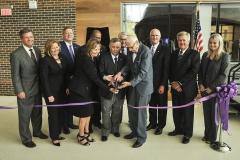
In conjunction with their quarterly meeting, Stephen F. Austin State University regents participated in a ribbon cutting to celebrate the opening of the Ed and Gwen Cole STEM Building. Pictured from left are SFA regents David Alders of Nacogdoches, Karen Gantt of McKinney, Dr. Scott Coleman of Houston, Brigettee Henderson of Lufkin and Alton Frailey of Katy; Dr. Baker Pattillo, SFA president; SFA regent Bob Garrett of Tyler; SFA benefactor Ed Cole; SFA regents M. Thomas Mason of Dallas and Ken Schaefer of Brownsville; and SFA student regent Kate Childress of Lumberton. Approximately 1,000 guests attended the event and were able to tour the building and observe demonstrations of the state-of-the-art instrumentation and laboratories.
SFA recently became the second Texas institution to offer a specialized degree in banking, and now, students enrolled in the Chadwick family banking program at SFA will have the added bonus of an advisory council.
Chadwick family banking program advisory council members will serve as a link between the classroom and the banking and financial services industries, while also providing mentoring opportunities to students.
“Industry engagement is an essential part of all we do in the Rusche College of Business, and it is especially important for the Chadwick family banking program,” said Dr. Tim Bisping, dean of the Rusche College of Business. “This advisory council will be an invaluable tool as we work to stay abreast of the latest developments in the banking industry in order to ensure graduates are successful in launching their banking careers.”
Council members will seek to strengthen educational opportunities for students and build relationships between the university and industry professionals. Dr. David Kaiser, director of the Chadwick family banking program, said this endeavor will help ensure students seeking a Bachelor of Business Administration in banking graduate with the knowledge and skills necessary to succeed.
“This council will help us build and maintain pathways for our students into the industry upon graduation,” Kaiser said.
Regents also approved five new courses to strengthen curriculum: international and intercultural communication – China; forecasting in economics and business; publication management and production; a publishing capstone course; and a practicum in professional and ethical practice. These curriculum changes will be sent to the Texas Higher Education Coordinating Board and the Southern Association of Colleges and Schools Commission on Colleges for further approval.
Regents approved an institutional operating budget totaling about $265.8 million for 2018-19. The budget reflects a 4-percent pool for merit salary adjustments and targeted strategic initiatives.
The board approved a capital plan budget of about $10 million for 2018-19. This budget follows goals outlined in the campus 2020 master plan, strategic plan and space assessment, which includes campus infrastructure, information technology services equipment, system and security initiatives, and planned maintenance renovation projects.
Improved academic support, student life, safety and capital renewal initiatives are all targets of the capital plan. Sand volleyball courts, which will allow SFA to offer a NCAA beach volleyball team, also are among the goals.
“Our goal is to increase the number of sports available to our female students,” said John Branch, assistant director of athletic external affairs. “Beach volleyball is a popular sport and will make us competitive with peer institutions. We hope to be ready for competition by spring 2020.”
Classrooms also will undergo technology upgrades to enhance instruction, and the number and capacity of virtual desktops will increase to provide greater access to high-quality graphic software.
For the James I. Perkins College of Education, the first-floor lobby areas in the McKibben Education Building are scheduled for renovation. In the Forestry Building of the Arthur Temple College of Forestry and Agriculture, about 45 workstations in the forestry geographic information system lab will be replaced.
In 2016, SFA added a crop science course into the core curriculum that accelerated the need to build a new greenhouse at the Pineywoods Native Plant Center. At the board meeting Tuesday, regents approved a $20,000 project budget increase to construct the 7,200-square-foot, three-bay, gutter-connected greenhouse.
Regents approved conducting an architectural assessment of property at 1401 N. Mound St., previously owned by Kay Bailey Hutchison, former U.S. senator and permanent U.S. representative to NATO. A space assessment was conducted by the San Antonio-based firm Facilities Programming and Consulting, with recommendations for use of the historic home located on the property. A comprehensive architectural design plan will be developed in accordance with those recommendations.
During the Tuesday meeting, the board also approved:
• ratifying $1.14 million in additional grant awards allocable to fiscal year 2018;
• policy revisions, curriculum and course fee changes, 2018-19 holiday schedule and minutes from the April meeting;
• an electrical infrastructure project that includes replacing a transmission line for the Student Recreation Center;
• a five-year agreement with three companies for debt collection services and a five-year contract extension with Accent Vending, which provides SFA’s vending services; and
• the annual audit plan.
The board received updates from Dr. Baker Pattillo, SFA president, regarding the university’s 95th anniversary celebration, which will take place Sept. 18.
Richards Carlberg delivered a report regarding the university’s marketing campaign, and Bentz Whaley and Flessner gave an update on the university’s fundraising campaign.
Additionally, regents heard reports from Dr. Buddy Himes, dean of the College of Fine Arts; Karen Gantt, chair of the Champions Event Committee; Craig Turnage, executive director of alumni relations and the SFA Alumni Association; the Faculty Senate; and the Student Government Association.