
This is a complete list of reports responded to by the Nacogdoches Police Department
This page may take a moment to load.
This is a complete list of reports responded to by the Nacogdoches Police Department
This page may take a moment to load.

This is the report from the Nacogdoches County Jail that lists the arrests made from 6 a.m. of the previous day to 6 a.m. of the listed day.

This page may take a moment to load
This is the report from the Nacogdoches County Jail that lists the arrests made from 6 a.m. of the previous day to 6 a.m. of the listed day.

This page may take a moment to load
If you are having trouble loading the mugshots please try using a different internet browser

The College of Fine Arts at Stephen F. Austin State University will present The Purple Xperience at 7:30 p.m. Friday, Nov. 30, in W.M. Turner Auditorium on the SFA campus.
A presentation of the College of Fine Arts and sponsored by Lehmann Eye Center, The Purple Xperience is a five-piece group that transports the spirit and sound of Prince direct from Minneapolis. Front man Marshall Charloff, who once recorded with Prince, channels the vocals and moves of the critically acclaimed icon in an unmatched, uncanny fashion, from his appearance to his multi-instrumental capacity, according to Scott Shattuck, associate dean of the College of Fine Arts and director of the University Series.
“Marshall Charloff styles the magic of Prince’s talent through his spot-on vocal imitation and brilliant performance on guitar and piano,” Shattuck said. “This is going to be a full-on rock concert that no one will want to miss.”
The Purple Xperience has entertained well over 300,000 fans and shared the bill with The Time, Cheap Trick, Gin Blossoms, Cameo, Fetty Wap, the Atlanta Rhythm Section and the Detroit Symphony Orchestra.
The concert is at 7:30 p.m. Friday, Nov. 30, in W.M. Turner Auditorium on the SFA campus. Prior to the performance, Herbert Midgley, music technology lecturer in the SFA School of Music, will present an informative talk at 7 p.m. in Griffith Gallery. The gallery is located across the hall from Turner Auditorium, which is inside the Griffith Fine Arts Building, 2222 Alumni Drive. The audience is invited back to the gallery for a post-performance reception to meet the performers and to honor the corporate sponsor.
Encore Event tickets are $45 for Section A seating; $36 for Section B seating; and $27 for Section C seating. Discounts are available for seniors, students, children and SFA faculty and staff members.
For more information, visit finearts.sfasu.edu, stop by the Box Office in Room 211 of the Griffith Fine Arts Building, or call (936) 468-6407 or (888) 240-ARTS.
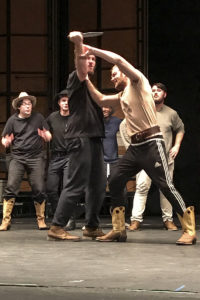
Theatre students Richard Rogers of Kerrville as Jud and exchange student Thomas Falconar of Gillingham, Gabon Republic, Africa, as Curly rehearse a fight scene in “Oklahoma!” with Shane Reynolds of Cumming, Georgia, Trace Killian of Forney, Myles Sands of Rosenberg and Tommy Vest of Gunter in the background.
Set in Oklahoma Territory at the turn of the 20th century, it tells the story of farm girl Laurey Williams and her courtship by two rival suitors, cowboy Curly McLain and farmhand Jud Fry. Between the story, the memorable music, the elaborate dancing and fight scenes that define “Oklahoma!,” the show has something for every audience member, according to Angela Bacarisse, professor of theatre at Stephen F. Austin State University and director of the show for the School of Theatre’s Mainstage Series.
A collaborative production between the university’s School of Theatre, School of Music and the Dance Program, “Oklahoma!” will seamlessly and artistically come to life nightly on W.M. Turner Stage Nov. 6 through 10. But the preparation behind the scenes, specifically fast-paced fight scenes and sweet love scenes, comes from a careful concentration on timing and technique. Slade Billew, assistant professor of acting and movement, is working with students on scenes that involve violence and intimacy.
“There are some big fights, mostly fist, in the play, but the weapons that are used must be very carefully choreographed so that no one gets injured,” explained Bacarisse. “And, you cannot imagine how awkward it can be the first time a young actor is asked to kiss someone who is, in truth, a stranger. There is a skill and a way of setting up those scenes that keeps it professional and relieves some of the tension. There are a lot of ‘young loves’ in this show who will be working on this aspect of the craft of acting.”
Fight choreography starts with discussions between the choreographer and the director about the style of the show and how the fights should feel to the audience, Billew said. Fight scenes in some shows will seem like real violence, while those scenes in others, like “Oklahoma!,” are more stylized, he explained.
“I like to create choreography in collaboration with the actors, so that I can better adapt to their abilities,” Billew said. “We build each fight using a combination of the actors’ understanding of their characters and my knowledge of both actual fighting and stage combat technique.”
Fight-scene safety is all about precision and control of distance, Billew said. The actors must do the moves the same way every time.
SFA theatre students who take movement courses learn unarmed and rapier/dagger fighting for the stage. In rehearsals, students learn the specific fights they are performing. For “Oklahoma!,” that included various punches, kicks and grappling maneuvers, depending on the fight. There are also some knife-fighting scenes and the use of some prop firearms, Billew said.
“Students who perform in these fights or use these prop weapons learn a variety of details of handling them for both safety and the illusion of reality,” he said “Also, in working on ‘Oklahoma!,’ we have used a heightened style that looks a bit more like the fights in a western movie from the 1950s as opposed to a more contemporary martial arts based style.”
Lastly, stage fights are performed a little slower than a real fight would happen. This is not necessarily for safety, but rather because faster movement makes it more difficult for the audience to follow the action, Billew explained.
At the other end of the spectrum are the love scenes in “Oklahoma!” Choreographing intimacy is a relatively new process in the theatre, said Billew, adding that he has only been working in this arena for the last few years since first encountering the work of Tonia Sina and her organization Intimacy Directors International.
“Stage intimacy, as I have learned to approach it, has five key elements: context, communication, consent, choreography and closure,” Billew said. “Culturally, theatre artists of all kinds often feel uncomfortable even talking about, much less staging, moments of physical intimacy. This has often led to unsafe practices of various kinds. Many of these issues have been brought forward in the past few years.
“Choreographing intimacy is about creating a rehearsal environment around intimate scenes that encourages open communication among the creative team,” he said. “We choreograph the intimate moments so that everyone feels safe and has consented to the staging. This makes the actors better able to commit to playing the moment because they know what is going to happen and are comfortable with it.”
Lastly, it can be difficult for any actor, but especially student actors to separate personal feelings from character feelings, Billew said. The closure process gives actors a way to remind themselves that their relationship to their scene partner is professional, and they are more easily able to keep their personal daily life separate from the character life they are exploring on stage, he explained.
For “Oklahoma,” choreography was used to both nuance and heighten moments, Billew said.
“Intimacy choreography allows us to explore details of intimate moments that we do instinctually in daily life, but that often gets left out on stage,” he said. “Something as seemingly simple as the hugs between Laurey and Curly are choreographed as a series of ‘moments’ rather than just a hug.”
Similar to the fights, the romance in “Oklahoma!” is bigger than is normally found in life.
“Oklahoma!” will be presented at 7:30 p.m. Tuesday through Saturday, Nov. 6 through 10, in W.M. Turner Auditorium in the Griffith Fine Arts Building, 2222 Alumni Drive, on the SFA campus.
Single tickets are $15 for adults, $10 for seniors and $7.50 for youth. Tickets for SFA students are $5. For tickets or more information, call the SFA Fine Arts Box Office at (936) 468-6407 or visit www.theatre.sfasu.edu.
The Stephen F. Austin State University Department of Languages, Cultures and Communication will host the annual International Poetry Reading at 6 p.m. Nov. 13 at The Cole Art Center @ The Old Opera House.
The event will feature SFA students, faculty, staff and community readers presenting poetry in a variety of non-English languages.
Past presenters have spoken in Spanish, French, Portuguese, Japanese, Chinese, Romanian, Russian, Greek, Latin, Bengali, Elvish and more.
“We ask each reader to briefly preview the poem in English, but, rather than rely on translations, we want audience members to appreciate and explore each language’s poetry on its own terms,” said Dr. Joyce Johnston, professor of French and co-coordinator of the event.
Readers often ask the audience to listen for a certain onomatopoeic sound, repetition or refrain in order for the audience to better understand the poem. Readers also may share the importance of the poem to its native language’s culture. Some presenters sing poems or present original works.
Fabiola Juarez, a senior political science major, has presented poems in French and Spanish. Participating in the readings in the past has taught her to be more appreciative of all languages, and she has enjoyed hearing poetry read and interpreted in different languages.
“This event is important because it exposes us to so many different languages and poetry. I feel like sometimes we don’t give much appreciation to other languages and poetry,” Juarez said. “However, this event makes us sit down and open our eyes and heart to such a wonderful experience.”
The event is part of the Department of Languages, Cultures and Communication international arts series. Throughout the year, the department hosts a variety of events that expose the SFA and Nacogdoches communities to international movies, books, music and more.
This event is open to the public, and free refreshments will be served.
For more information, contact Johnston at (936) 468-6722 or Dr. Louise Stoehr, associate professor of German, at (936) 468-2167.
By Emily Brown, marketing communications specialist at Stephen F. Austin State University.
SFA Board of Regents approves faculty and staff appointments
Stephen F. Austin State University’s Board of Regents approved various leadership changes during its Monday quarterly meeting.
Dr. Mark Sanders, professor, was appointed associate dean of the College of Liberal and Applied Arts. Sanders has been a part of the SFA faculty since 2008, serving in various roles such as department chair and English professor. He has more than 40 years of experience in education at the collegiate and secondary education levels.
In the College of Sciences and Mathematics, Dr. Michele Harris, chemistry professor, was named associate dean. Since 1994, Harris has been a member of the SFA faculty, where she has served as assistant professor, associate professor, professor, graduate advisor, and assistant chair of the Department of Chemistry and Biochemistry.
Regents also appointed physician Dr. Janice Ledet as director of health services. Ledet was licensed by the Texas State Board of Medical Examiners and began practicing at SFA’s health clinic in 1986.
BUSINESS
Faculty appointments approved for the Rusche College of Business included assistant professors Thomas Branton and Jose Vega, accounting; Wenjing Li, management and marketing; and Rebecca Davis, economics and finance.
In the Department of Management and Marketing, Antoine Busby was approved as a visiting assistant professor, and William Kirkpatrick was approved as clinical instructor. Lecturers Nicole Brantley, accounting, and Laurie Rogers, business communication and legal studies, also were approved.
EDUCATION
Brandon Fox, James I. Perkins College of Education associate professor, was appointed as interim assistant chair of the Department of Elementary Education. Professor Gloria Gresham was appointed as interim assistant chair of the Department of Secondary Education and Educational Leadership.
Amber Wagnon, who formerly served as a lecturer of English and creative writing, was approved as associate professor of secondary education and educational leadership, and Cyndra Krogen-Morton, a Title IX specialist, was approved as visiting lecturer of kinesiology and health science.
In the Department of Kinesiology and Health Science, Mi Hae Bae was approved as assistant professor, and Sharon Rice was approved as an instructor. Assistant professors Shannon Darst and Summer Koltonski, human services, and Mychelle Smith, secondary education, also were approved. Mandy Seybold was approved as lecturer of human services.
Regents approved the SFA Charter School appointments of Juliana Akerson, Madison Taylor and Brooke Taylor-Johnson as teachers, and Jacklyn Hamilton as a substitute teacher.
FINE ARTS
The promotion of David Campo from associate professor to professor of music and director of bands was approved. Christopher Kaatz was approved as assistant professor of music and assistant director of bands, and Pierre-Alain Chevalier was approved as visiting lecturer and director of orchestral activities.
The following changes also were approved: Alexander Amato, from lecturer to assistant professor of music; Tamey Angley, from assistant professor to professor of music; Lee Goodhew, from visiting assistant professor to associate professor of music; Kirsten Nelson, from assistant professor to lecturer of music; and Kenneth Verdugo, from visiting assistant professor to assistant professor of theatre.
In the School of Theatre, Rosemary Brownlow-Calkin was approved as visiting professor, and Jennifer Malmberg and Jackie Rosenfield were approved as lecturers.
Nicholas Lambson was approved as visiting lecturer of music and Thomas Nixon as accompanist. Margaret Leysath was approved as visiting assistant professor of art.
FORESTRY AND AGRICULTURE
In the Arthur Temple College of Forestry and Agriculture, Sheryll Jerez, associate professor, was named interim associate dean of the college. Jason Paul was approved as instructor of forestry, and Sabrina Thomas was approved as an agriculture lab associate.
LIBERAL AND APPLIED ARTS
Professor Mark Barringer was appointed as director of research, and Matthew McBroom, associate dean of forestry, was approved as interim chair of English and creative writing.
Aparecida Cordeiro Dutra, a Heritage Research Center associate, and Kelsey Pelham, visiting lecturer, were approved as lecturers in languages, culture and communication.
In the Department of Mass Communication, Yiran Wang was approved as assistant professor and Phillip Anderson was approved as instructor.
Approval was received for Megan Fleming, lecturer of government, and Jennifer McLaughlin, visiting lecturer of English and creative writing.
The following changes also were approved: Rhanda McGee, from adjunct faculty to lecturer of English and creative writing; Kristi Warren, from adjunct faculty to lecturer of psychology; and Charles White, from visiting instructor to lecturer of psychology.
SCIENCES AND MATHEMATICS
In the College of Sciences and Mathematics, William Bradford, Brooke Busbee and Cheryl Janusa were approved as lecturers of mathematics and statistics, and Marissa Rotenberry was approved as a visiting lecturer.
Also approved were:
. Erin Childress, lecturer of biology, and Ray Kamps, visiting assistant professor
. Kelley McDonald and Vanessa Pacheco, clinical instructors of nursing
. Puntitra Glendowne, assistant professor of computer science
. and Adrienne Bay, STEM programs coordinator.
In the Steen Library, Edward Kownslar was approved as librarian III.
In Information Technology Services, regents granted the following changes of status: David Justus, from associate director of library technology to compliance coordinator; Jon Laurent, from technical support specialist I to security specialist I; Timothy Lewallen, assistant manager of technical support to assistant director of customer service; and Jennifer Stringfield, from assessment specialist to project analyst.
In the Department of Athletics, Jeffrey Byrd’s appointment as interim head football coach was approved, along with Erin Scott’s appointment as head tennis coach. Other approvals included Alisa Blair, assistant volleyball coach; Cody Dukquits, conditioning professional specialist; Ryan Friedline, marketing coordinator; and Hadrien Choukroun and Hunter Key, assistant track coaches.
In Residence Life, staff appointments were approved for hall directors Jamyia Barrett, Jonathan Boulanger, Jamil Frech and Natalie Roberts. Lori Havard was approved as area coordinator and LaShirine Howard as hall director.
Approvals in the student affairs division included Jalon Berry, assistant director programs for multicultural affairs; April Chaney, compliance specialist for Title IX investigations; MacKenzie Enderwitz and Clare Fite, counselor interns; Julia Denhollem, student engagement coordinator for Greek Life; and Rhylie Gachot, assistant director for orientation.
In Academic Affairs, Stephanie Weatherford was approved as Academic Assistance and Resource Center program director, and Mary Smith, assistant director of instructional technology, was approved as interim director.
William Boucher was approved as Campus Recreation coordinator for fitness and wellness, and Tierney White was approved as coordinator in the Center for Career and Professional Development.
In the University Police Department, Lt. Marcus Madden was approved as interim associate director and assistant chief. Kallie Westmoreland was approved as accountant II in the Controller’s Office.
Regents approved the retirements of employees with 113 years of combined service to the university. Shelly Lackey, director of divisional operations for university affairs; Sean Lonergan, assistant track coach; Phil Stetz, professor of management and marketing; Larry O’Neal, associate professor of management and marketing; and Treba Marsh, professor of accounting.
-SFA-
Shirley
Shirley Luna, Ed.D. | Executive Director | University Marketing Communications
Stephen F. Austin State University
Austin Building Room 121
P.O. Box 6100 – SFA Station
Nacogdoches, Texas 75962
936.468.2605 | Fax 936.468.1732
The views and opinions expressed in this message are my own and do not necessarily reflect the views and opinions of Stephen F. Austin State University, its Board of Regents or the state of Texas.
Members of Stephen F. Austin State University’s Board of Regents acknowledged the institution’s 95th anniversary by approving the launch of one of the largest building initiatives in SFA’s history. Construction projects approved include a welcome and student support center, expansion of buildings utilized by the College of Fine Arts, construction and renovation of student residential and dining facilities, and a basketball practice facility.
Dr. Steve Westbrook, vice president for university affairs, said the projects will allow the university to provide learning and living environments that foster collaboration and connections with others and prepare students for life-long learning and career responsiveness in the 21st century.
“For the past 95 years SFA has had an impact on both our state and our region,” Westbrook said. “To continue that impact, we must position the university to meet the needs of our future students and to provide transformational experiences for them in an exceptional setting. These construction projects will help us enhance the experience for all students, beginning as early as their first year on campus.”
The Kennedy Auditorium, constructed in 1966, will be renovated for use as a welcome center and “one-stop shop” for prospective students and visitors. To support the welcome center and expand one-stop-shop student services, the Rusk Building will be renovated to include student support services provided by departments including admissions, academic advising, business office, financial aid, registrar and residence life.
A recent study of the SFA campus conducted by Facilities Programming and Consulting, a strategic facilities planning agency, examined ways to provide additional service and support for prospective students, visitors and currently enrolled students. Among the agency’s recommendations was the creation of a welcome center staffed by university employees who provide information about a variety of topics, including admission and academics, billing and payments, financial aid, and campus life and housing.
Erma Nieto Brecht, executive director of enrollment management, said the study also recommended the renovation of the Rusk Building to consolidate expanded delivery of those services.
“We live in a technology-driven world; however, selecting a college is a significant decision for the student and the family,” Brecht said. “In order to enhance the SFA experience for both prospective and current students, it is important to find a balance of both automation and personal service.”
Brecht said a process will be implemented so information is provided to prospective and current students without the need for them to be “ping-ponged” between buildings across campus. The estimated cost for the welcome center and student support services project is $13 million.
The Facilities Programming and Consulting study also identified needs in the College of Fine Arts.
“This is an absolutely unprecedented time in the history of the College of Fine Arts,” said Dr. Buddy Himes, dean of the College of Fine Arts. “New construction will allow the College of Fine Arts to alleviate concerns for space, grow to its potential in enrollment, be competitive with similar programs in Texas and fully capitalize upon student markets for new programs.”
Construction will more than double the size of the Griffith Fine Arts Building, which was built in 1959, while maintaining some of the historic components. Among the new facilities will be a 350-seat main theatre and an intimate black box theatre.
Himes explained that the facilities will allow SFA to merge the dance program, currently housed in the Department of Kinesiology and Health Science, with the School of Theatre, and to begin a new program in musical theatre. The new facilities will allow the School of Art’s filmmaking program to move from the 1923 “film house” on Starr Avenue to modern facilities specifically designed for that discipline.
The estimated project cost for the fine arts expansion initiative is $37 million.
“Music’s sound recording technology program will have a new recording studio. This, combined with two full time SRT faculty members and a corps of some 80 majors, will make our program the premier SRT program in Texas,” Himes said.
The university’s campus master plan includes the development of a new first-year student residence hall and the renovation of existing residential facilities to enhance student life and increase the attractiveness of these facilities for prospective students. In addition, the renovation or replacement of the current East College Dining Hall and renovations to other existing dining facilities will more efficiently provide the flexibility needed to meet the demand for contemporary food-service options.
“East College Cafeteria was opened in 1968, and the way it was constructed, while modern at the time, has proven a challenge for us when trying to accommodate the needs of a contemporary dining services program,” Westbrook said. “We will determine if we can adequately renovate the existing structure to meet our students’ needs or if it will need to be replaced by a new facility.”
A new 400-bed residence hall is planned for construction on the east side of Lumberjack Landing, a residence hall constructed in 2010.
“This project is part of our long-term strategy to continue updating our student residential facilities, both by the construction of a new, state-of-the-art residence hall and by the on-going renovation of existing residential facilities,” Westbrook said.
The estimated project cost for the student residential and dining facilities project is $39.5 million.
Regents selected Kirksey Architecture as the firm to design the welcome and student support center, fine arts facilities, and student residential and dining facilities. Based in Houston, Kirksey Architecture has decades of experience and designed SFA’s new Cole STEM Building and Lumberjack Landing.
The university’s current campus master plan also includes development of athletic facilities. At the January 2018 meeting, regents selected Gensler Architects to conduct an athletic facilities assessment. The agency’s proposal to the Board of Regents’ Athletic Subcommittee recommended support space for men’s and women’s basketball, including a practice court, locker rooms, athletic training room, office and lounge areas, and equipment storage.
“The new basketball performance center will provide us with an opportunity to continue to grow our athletics department,” said Ryan Ivey, director of athletics. “Having quality and functional facilities is something that is critical to our ability to achieve long-term success. Our vision is to become the leading mid-major athletics department in the nation, and this is the first step in achieving that vision.”
Regents selected Populous to design the new athletic facilities. Consistently ranked the most innovative company by Fast Company Magazine, the Populous firm has designed more than 2,500 facilities, including projects at London Olympic Stadium and Wimbledon Centre Court.
The board selected Kingham Dalton Wilson as the construction company for all of the approved construction initiatives. A Houston-based company, KDW has more than 115 years of experience and has completed more than 1,000 projects.
To fund the construction, a series of revenue financing system bonds will be issued in an amount not to exceed $125 million. The university will utilize cash reserves to fund construction-related expenses prior to the bond issuance, but regents authorized administrators to obtain short-term financing for expenses, if necessary. If a short-term financing proposal is selected, terms and pricing will be brought back to the Board of Regents at a later meeting for approval.
Regents approved a $10 increase in the university services fee, to be set at $83 per semester credit hour, effective fall 2019. Regents also approved a 6.5-percent increase in room rates for both the fall 2019 and fall 2020 semesters. After the increases, SFA room rates will be 22 percent below the median rate for suite-style residence halls charged by other Texas universities and 26 percent below the median rate for halls with common bathrooms, according to Westbrook.
Regents approved SFA’s 2020-21 Legislative Appropriations Request to the Texas Legislative Budget Board, which included a $2 million biennial request to fund a STEM/early childhood initiative and a tuition revenue bond capital request to construct a $48 million Natural Resources Science and Innovations Laboratory.
While the $46.4 million Cole STEM Building was considered substantially complete when classes began in the fall 2018 semester, Regents approved an $850,000 increase in the project budget, bringing the total budget to $47.25 million.
According to Dr. Danny Gallant, vice president for finance and administration, since the project began, tuition revenue bond proceeds have been invested, and current investment earnings total $778,491. Using current interest rates, those earnings are expected to amount to $850,000.
“Utilizing those earnings, along with savings that have accumulated as a result of construction costs that have come in under budget, we have an opportunity to complete components of the Cole STEM Building project that were planned initiatives, which we expected to complete at some point in the future,” Gallant said.
A portion of the funding will be utilized to improve the Griffith Drive entrance to the facility.
With the board’s approval, the university will purchase property located at 1521 Baker St. to enhance student parking, along with a new shuttle bus to transport students to and from parking lots, at a cost not to exceed $200,000.
Regents approved the purchase of a 52-passenger bus at a cost not to exceed $615,000.
Regents approved a contract with SirsiDynix for a cloud-based integrated library system and the purchase of Nuventive Improve assessment software. The assessment software will allow the university to collect data from multiple sources and tie that data to existing goals and objectives in order to make data-informed decisions associated with the SFA Envisioned Strategic Plan through student learning outcomes.
The university will continue to lease office and classroom space at the Lone Star College’s university center in The Woodlands to offer courses to Houston-area students.
Curriculum changes approved for fall 2018 include music performance courses for Italian, English, French and German diction and various courses in English and interdisciplinary studies. The board approved adding a graduate certificate in teaching psychology and a graduate course in psychology.
Additional items approved during the meeting Monday include:
– financial affairs, academic and student affairs, and building and grounds policy revisions, as well as revisions to board rules and regulations;
– the receipt of an audit services report and the annual audit report and audit charter;
– an additional $113,484 in grant awards for fiscal year 2018 and approximately $3 million for fiscal year 2019;
– an extension on a medical insurance billing contract with Vivature through Dec. 31, 2019, for the university health clinic; and
– course fee changes and minutes from the July Board of Regents meeting.
Regents heard reports regarding contract monitoring, current campus construction and enrollment management. Faculty Senate Chair Dr. Jason Reese and Student Government Association President Jeffrey Agouna-Deciat also delivered reports to the board.
-SFA-
Shirley
Shirley Luna, Ed.D. | Executive Director | University Marketing Communications
Stephen F. Austin State University
Austin Building Room 121
P.O. Box 6100 – SFA Station
Nacogdoches, Texas 75962
936.468.2605 | Fax 936.468.1732
The views and opinions expressed in this message are my own and do not necessarily reflect the views and opinions of Stephen F. Austin State University, its Board of Regents or the state of Texas.
The Cello Club at Stephen F. Austin State University will present a concert dedicated to peace at 6 p.m. Saturday, Nov. 10, in Cole Concert Hall on the SFA campus as part of the Friends of Music Concert Series.
The concert’s theme of peace commemorates 100 years since the armistice that ended World War I, according to Dr. Evgeni Raychev, instructor of cello in the SFA School of Music.
“All of the compositions on the program are original arrangements and transcriptions from a wide range of genres; they will be heard for the first time in this ensemble form,” Raychev said.
The program will range from works by Franz Schubert and Pyotr Ilyich Tchaikovsky to music by Heitor Villa-Lobos and the English rock band Deep Purple.
“All arrangements will be familiar, and the listener will recognize tunes from the sweet lyricism of Schubert and Tchaikovsky all the way to the exotic sounds of Villa-Lobos and the heavy riff-based music of Deep Purple,” Raychev said.
Cello Club is an ensemble that has been prepared through one-on-one communication between each performer and Raychev, either in person or through the Internet. The performance will gather on Cole stage more than 30 cellists from throughout state of Texas.
The concert is a presentation of the College of Fine Arts and School of Music. Admission is free. For more information, call the SFA Fine Arts Box Office at (936) 468-6407 or visit www.finearts.sfasu.edu.
Stephen F. Austin State University’s planetarium in the Cole STEM Building will open Nov. 3, taking visitors on immersive journeys of scientific discovery.
Seating 119, the planetarium provides a unique learning space for all ages, offering more than 20 new programs, covering astronomy, biology, chemistry, climate science, Earth science, engineering, geology and space science.
“The SFA planetarium is like a simulated space ship staffed with knowledgeable tour guides so visitors can explore the wonders of the universe,” said Ed Michaels, planetarium director and lecturer in the Department of Physics, Engineering and Astronomy.
Public shows will be offered every Saturday, with group shows available throughout the week by reservation. Before each show, Michaels will give a tour of the current night sky, pointing out planets, stars and constellations.
Starting Nov. 3, two shows will be offered. “Molecularium” introduces audiences to the world of atoms and molecules and will be presented at 2 p.m. Though geared toward children ages 5 to 8, the show is open to all ages. Tickets are $3.
“Dark Universe” will be presented at 4 p.m. and 7 p.m., letting audiences explore deep space and learn about dark matter and dark energy. Tickets are $6 for adults and $4 for children, students, and faculty and staff with ID.
Tickets will be available for purchase at the planetarium box office 30 minutes before each show.
To learn more information about shows, view the schedule or make a reservation, visit planetarium.sfasu.edu/home.
By Joanna Armstrong, marketing communications specialist at Stephen F. Austin State University.