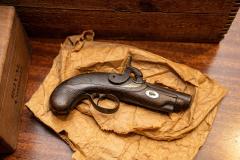
A derringer pistol believed to have been given by Sam Houston to East Texas physician Dr. John Newton Fall in the mid-1800s was donated to the Stone Fort Museum at Stephen F. Austin State University Monday.
A derringer pistol believed to have been given by Sam Houston to an East Texas physician in the mid-1800s was donated to the Stone Fort Museum at Stephen F. Austin State University Monday.
The firearm, which had been stored in a paper bag for nearly 90 years, was donated by descendants of Dr. John Newton Fall, a family physician and member of the Texas Senate from 1857 to 1861.
“Family legend says that the derringer was given to my great-great-grandfather by Sam Houston in appreciation for medical care,” said Patricia Layne, who inherited the pistol from her aunt, the late Kathleen Gray Rollins of Henderson. “We’re happy this piece of history can now be studied by others.”
Fall was born in Georgia in 1810 and moved to Chireno in 1837. In addition to practicing medicine, he served as senator for District 13, which then included Angelina and Nacogdoches counties. He died in 1866 at age 56 and is buried in Lower Chireno Cemetery.
Museum staff said the derringer is in surprisingly good condition, considering its age and storage history. It also managed to survive Hurricane Ike’s path through Henderson in 2008, though the home it was stored in at the time had to be demolished.
“This firearm offers an intimate glimpse into the personal sidearms carried by Texans during the Republic and early statehood,” said Carolyn Spears, Stone Fort Museum director who has documentation of Houston’s visit to Nacogdoches County for medical assistance from Fall. “It helps illustrate how history is often preserved through family stories and heirlooms.”
Layne also donated 19th-century family photographs and books to SFA’s East Texas Research Center.
“We are so excited to be keeping and preserving these historical materials here in East Texas,” said Kyle Ainsworth, ETRC special collections librarian.
Private donations like this are integral to helping East Texans understand their history, Spears said. Donating artifacts to such institutions as the Stone Fort Museum and ETRC can ensure their safety while helping SFA students and the general public explore local culture.
“But it requires a relationship built on trust,” Spears said. “This is a commitment to the long-term maintenance of these artifacts. Private donors need to be able to trust us to take care of their items as they help us tell the stories of East Texas.”
The pistol will be on display at the Stone Fort Museum starting in late January.
For information about the Stone Fort Museum and upcoming events, including the Old Stone Harvest Fest from 4 to 8 p.m. Oct. 25, visit sfasu.edu/stonefort. For more information about the East Texas Research Center, visit sfasu.edu/library/archives.
ABOUT STEPHEN F. AUSTIN STATE UNIVERSITY
Stephen F. Austin State University, the newest member of The University of Texas System, began a century ago as a teachers’ college in Texas’ oldest town, Nacogdoches. Today, it has grown into a regional institution comprising six colleges — business, education, fine arts, forestry and agriculture, liberal and applied arts, and sciences and mathematics. Accredited by the Southern Association of Colleges and Schools, SFA enrolls approximately 11,000 students while providing the academic breadth of a state university with the personalized attention of a private school. The main campus encompasses 421 acres that include 40 academic facilities, 11 residence halls, and 68 acres of recreational trails that wind through its six gardens. The university offers more than 80 bachelor’s degrees, more than 40 master’s degrees and four doctoral degrees covering over 120 areas of study. Learn more at sfasu.edu.
By University Marketing Communications